
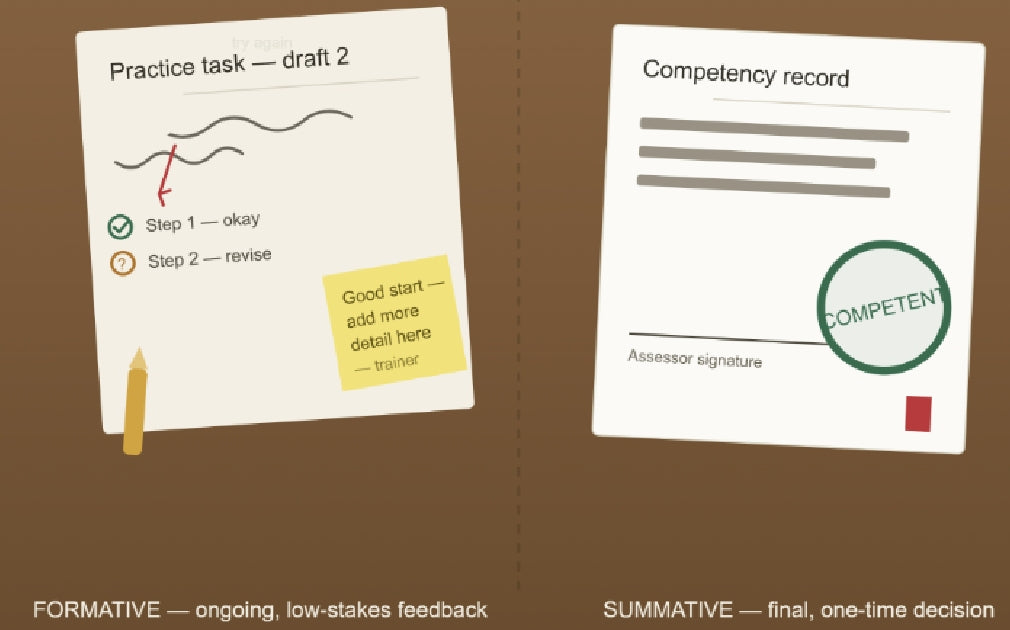
The Outcome Standards never use the words formative or summative. They use training and assessment, and they attach different obligations to each. Two questions recur in the sector: can a formative activity contribute to the final competency judgement, and why does ASQA treat missing assessment feedback as a finding when the word feedback barely appears where practitioners expect it? Both resolve once the line between training under Standard 1.1 and assessment under Standards 1.3 and 1.4 is drawn precisely, and what that line means for RTOs, trainers, assessors and students is the subject of this analysis.
Two Words the Standards Do Not Use
Two questions submitted to ASQA at a recent sector webinar identified a persistent confusion in VET training and assessment practice. The first asked whether formative assessment is only a learning and feedback activity, or whether it can also contribute towards the final competency judgement. The second, closely related, asked why a lack of assessment feedback is identified as a compliance issue when neither the Outcome Standards nor the practice guides explicitly mention assessment feedback as a requirement. Together these questions reveal a sector unsure where the line falls between training and assessment, and why activities on either side of that line carry different regulatory obligations.
The resolution begins with vocabulary. The Outcome Standards do not use the phrase formative assessment anywhere, and they do not use summative assessment either. These are pedagogical terms describing how assessment is used relative to learning, drawn from educational theory rather than regulatory drafting. The Standards use a different and more precise vocabulary: training and assessment are treated as distinct functions, each governed by specific provisions, with different obligations attached to each. Drawing that line precisely, in the language of the Standards themselves, resolves both questions the webinar raised.
1. How the Outcome Standards Frame Training and Assessment
Standard 1.1 governs training. It requires training to be engaging and well structured and to enable students to attain skills and knowledge consistent with the training product. Standard 1.1(2)(c) is the provision most relevant to the formative-summative question: it requires training to be structured and paced to support students to progress, providing sufficient time for instruction, practice, feedback and assessment. The sequence matters. Instruction, practice, feedback and assessment are four distinct stages in a structured training cycle, and feedback appears explicitly as part of the training function, positioned between practice and assessment.
Standard 1.3 governs the assessment system, requiring it to be fit for purpose and consistent with the training product. Standard 1.4 governs individual assessment judgements, specifying the principles of assessment and the rules of evidence that must govern every competency determination. The assessment function produces binding, recorded outcomes: a finding of competent or not yet competent that becomes part of the student's record and, where competency is achieved, supports the issuance of AQF certification documentation.
The distinction between these two domains is therefore not primarily a distinction between formative and summative in the educational-theory sense. It is a distinction between activities whose purpose is to support learning and activities whose purpose is to determine and record competency. An activity whose purpose is to help the student learn, practise and improve is a training activity under Standard 1.1, however closely it resembles an assessment task in its format. An activity whose purpose is to determine whether the student has achieved competency, and to record that determination, is an assessment activity under Standards 1.3 and 1.4.
|
Purpose, Not Format |
|
Training activities, including formative tasks, exist to support learning and generate feedback. Assessment activities exist to determine and record competency. The distinction is one of purpose, not format. The same task, such as a written response to a scenario, can be a training activity in one context and an assessment activity in another, depending on its purpose and how the outcome is used. |
2. Standard 1.1(2)(c): Where the Feedback Obligation Lives
Standard 1.1(2)(c) is the legislative home of the feedback obligation in VET. Its requirement that training provide sufficient time for instruction, practice, feedback and assessment is not merely a description of good pedagogy. It is the Standard's specification of what structured training must contain.
Instruction is the delivery of knowledge and skills content. Practice is the student's opportunity to apply what they have learned in a context that allows errors, experimentation and refinement without the consequences of a competency determination. Feedback is the trainer's or assessor's response to that practice: what was done well, what needs improvement, and how the student can develop their performance before formal assessment. Assessment is the determination of competency, conducted after instruction, practice and feedback have given the student a genuine opportunity to reach the required standard.
The feedback element is the basis of ASQA's recurring finding that inadequate assessment feedback is a compliance issue, and that finding confuses many practitioners because they read assessment feedback as feedback given after a competency determination, a notification of the outcome. But the feedback in Standard 1.1(2)(c) is pre-assessment feedback given during the practice stage, before the summative determination is made. When ASQA identifies inadequate assessment feedback, it is typically identifying one of two problems: either no feedback was provided during the practice stage before formal assessment, or feedback was provided but was insufficiently specific, actionable and connected to the assessment criteria to support the student's development.
|
Feedback Means Before, Not After |
|
The feedback element of Standard 1.1(2)(c) is pre-assessment feedback provided during the practice stage, not a post-assessment notification of the outcome. An assessor who records a not-yet-competent determination without having provided specific, actionable, criteria-referenced feedback during practice has not satisfied Standard 1.1(2)(c). Read with the fairness principle under Standard 1.4, the student was assessed without the feedback the Standard requires as a precondition of fair assessment. |
An assessor who marks a student not yet competent without having provided specific, actionable, criteria-referenced feedback during the practice stage has not satisfied Standard 1.1(2)(c), and the fairness principle under Standard 1.4 reinforces the point: assessment must accommodate the needs of the student, which includes a genuine opportunity to receive feedback and improve before competency is formally determined.
3. The Assessment System Under Standard 1.3
Standard 1.3 requires the RTO to have an assessment system that is fit for purpose and consistent with the training product. Its performance indicators require the system to ensure assessment is conducted consistently with the training product, require assessment tools to be reviewed prior to use to ensure assessment can be conducted consistently with the principles of assessment and the rules of evidence under Standard 1.4, and require the outcomes of those reviews to inform changes to the tools.
The assessment system is the architecture that governs how competency determinations are made. It specifies which tasks constitute summative assessment, how those tasks are sequenced within the program, what criteria and decision rules apply to each, how evidence is collected and stored, how assessors make and record their judgements, and how the system ensures every determination is supported by valid, sufficient, authentic and current evidence.
Formative activities, in their formative capacity, are not part of the Standard 1.3 assessment system. They are part of the Standard 1.1 training system. However, evidence generated during a formative activity can, under specific conditions examined below, be incorporated into the summative evidence base. When this occurs, the formative activity transitions from a training activity to an assessment evidence source, and the Standard 1.4 rules of evidence apply to the evidence it generates. This transitional capacity is the source of most of the confusion the webinar questions reflect. Practitioners who understand that formative activities can sometimes contribute to summative judgements, but who are uncertain about the conditions, often default to one of two unhelpful extremes: treating all formative activities as having no evidential value whatsoever, or treating all formative activities as potentially summative without applying the Standard 1.4 tests.
4. Can Formative Evidence Contribute to a Competency Judgement?
The answer to the webinar question is yes, under conditions. The conditions are set by the rules of evidence under Standard 1.4, which require every piece of evidence used in a competency judgement to satisfy validity, sufficiency, authenticity and currency. Evidence generated during a formative activity either satisfies these rules, or it does not, regardless of whether the activity was originally intended as formative. The question is therefore not whether the activity was formative or summative in design, but whether the evidence it generated satisfies the rules, and whether the assessment system under Standard 1.3 has been designed to incorporate that evidence into the judgement in a way that is transparent to the student.
Two conditions must be met. First, the evidence must satisfy the Standard 1.4 rules of evidence as if it had been designed as summative evidence from the outset. If the formative activity was a low-stakes practice task with no authenticity controls, no criteria-referencing and no assessor oversight, the evidence it generates will not satisfy the authenticity or validity rules. Second, the student must have been informed, in the assessment plan and before the activity was conducted, that the evidence from the activity may be used in the competency judgement. Using formative evidence summatively without the student's foreknowledge contravenes the fairness principle under Standard 1.4: the student was not given the opportunity to prepare and perform knowing the activity was being assessed.
5. Formative and Summative Compared
The following table maps the key dimensions of formative and summative activity against the Standards obligations that apply to each, and identifies where the two domains can legitimately overlap.
|
Dimension |
Formative (Training Function) |
Summative (Assessment Function) |
|
Primary purpose |
Support learning, identify gaps, develop competency, guide practice. The output is feedback and improvement, not a recorded determination |
Determine whether competency has been achieved. The output is a recorded judgement of competent or not yet competent that supports AQF certification |
|
Governing Standard |
Standard 1.1, especially 1.1(2)(c): training must provide instruction, practice, feedback and assessment |
Standards 1.3 and 1.4: the assessment system must be fit for purpose, and assessors must make individual judgements justified by the rules of evidence |
|
Feedback obligation |
Specific, actionable, criteria-referenced feedback is the primary output, required as a training stage under Standard 1.1(2)(c) and as a precondition of fair assessment under Standard 1.4 |
Post-assessment feedback communicating the outcome, the basis for it, and, where not yet competent, what the student must do to achieve competency, is a fairness obligation under Standard 1.4 and a support obligation under Standard 2.3, not a Standard 1.1(2)(c) obligation |
|
Authenticity controls |
Low-stakes formative activities typically do not require the same authenticity controls; the purpose is practice, not proof |
The authenticity rule under Standard 1.4 requires the assessor to be assured the evidence is the genuine work of the student, with controls appropriate to the risk of non-genuine work |
|
Can evidence contribute to a competency judgement? |
Yes, under conditions: the evidence must satisfy the Standard 1.4 rules, and the student must have been informed in the assessment plan that the activity may generate evidence used in the judgement |
Yes. All summative evidence is evaluated against the Standard 1.4 rules of evidence to support the individual assessment judgement |
|
Recording obligation |
No mandatory recording obligation under the Standards for purely formative activities; good practice is to retain records to support awareness of the student's development |
Standard 1.3 and the Compliance Standards require assessment outcomes to be recorded accurately, since AQF certification depends on accurate and complete records |
|
Relationship to assessment tools |
Formative tasks may use informal or internally designed materials that have not been through the Standard 1.3 pre-use review, provided they are used only for formative purposes |
All tools used to generate summative evidence must be reviewed under Standard 1.3 before use, to ensure assessment can be conducted consistently with the principles of assessment and rules of evidence |
6. The Conditions Under Which Formative Evidence Can Become Summative
The following framework applies the Standard 1.4 tests to specific scenarios where practitioners often ask whether formative evidence can contribute to a competency judgement.
|
Scenario |
Can It Be Used Summatively? |
Rules of Evidence Analysis |
|
A student completes a written knowledge task during a workshop for discussion, under trainer supervision, with their name attached, and the response reflects the student's own analysis of a case study |
Yes |
Validity is satisfied if the task assesses relevant knowledge; sufficiency depends on whether it is the sole evidence or part of a broader base; authenticity is satisfied by supervision, naming and personalised content; currency is satisfied if recent. Condition: the student must have been told in the assessment plan that workshop tasks may generate summative evidence |
|
A student submits a draft for feedback, the trainer marks it up, and the student revises and submits the revised version as their formal assessment |
Yes |
The revised final submission is the summative evidence; the draft is training material. Validity and sufficiency apply to the final submission, and authenticity is not compromised by the drafting process provided the student produced the revision. Condition: the assessment plan must specify that the submitted version following feedback is the assessed document |
|
A student completes a practice observation checklist during a workplace visit, the supervisor initials it, and it is retained on file |
Depends |
Validity depends on whether the checklist was designed against specific performance criteria; authenticity depends on whether the initials confirm the student performed the tasks or merely that the form was completed; currency depends on the date. Designed and completed as if summative, it may satisfy all four rules; as a practice-only form with no criteria-referencing, it does not satisfy validity as standalone summative evidence |
|
A student makes comments in a class discussion demonstrating knowledge, and the trainer notes the contribution |
No |
Validity is not satisfied, because unrecorded oral contributions cannot be verified against specific criteria; authenticity is not satisfied, because a note that a student contributed is not assured evidence of individual knowledge; sufficiency is not satisfied for any criterion. Structured oral assessment under Standard 1.4-compliant conditions, with specific questioning and documented responses, is a different thing |
|
A student completes a formative quiz on the learning platform with no time limit and external resources permitted, automatically recorded |
No |
Authenticity is not satisfied, because open-resource, unlimited-time conditions do not allow the assessor to be assured the result reflects the student's own knowledge, and validity is questionable because the conditions do not reproduce those the training product requires. The result is training data, not summative evidence |
|
A reflective journal maintained throughout a workplace placement documents specific instances of performing relevant tasks, with dates, contexts and supervisor confirmation of each entry |
Yes |
Validity is satisfied if entries reference specific criteria or knowledge evidence; sufficiency depends on the number and range of instances; authenticity is satisfied by supervisor confirmation and personalised content; currency is satisfied by documented dates. Condition: the assessment plan must specify that the journal forms part of the evidence base |
7. Documenting the Boundary: What Assessment Tools Must Specify
The confusion between formative and summative often originates not in a misunderstanding of the Standards but in poorly designed assessment tools that do not specify what function each component serves. When a tool includes both practice activities and summative tasks without distinguishing them, students do not know which activities are being assessed, trainers are uncertain whether feedback during practice is the Standard 1.1(2)(c) pre-assessment feedback or post-determination feedback under Standard 2.3, and assessors cannot determine which evidence contributes to the judgement. Standard 1.3 requires assessment tools to be reviewed prior to use to ensure assessment can be conducted consistently with the principles of assessment and rules of evidence. A tool that does not clearly distinguish summative from formative components cannot be assessed for that compliance, because it has not specified which activities carry competency-determination weight.
|
Ambiguity Is Itself a Finding |
|
An assessment tool that does not clearly distinguish summative components from formative components cannot be assessed for compliance with the Standard 1.4 principles, because the tool has not specified which activities carry competency-determination weight. That ambiguity is itself a Standard 1.3 compliance issue. The tool must state, for each component, whether it is being assessed. |
The student-facing document, often called the student assessment pack or learner workbook, must specify for each component whether it is a practice task, a formative activity, or a summative task contributing to the determination, whether feedback will be provided before any summative determination and in what form, and what the student must do to demonstrate competency. A student who cannot tell from the documentation which tasks are formally assessed cannot prepare appropriately, which is a fairness failure under Standard 1.4. The assessor-facing guide must specify the decision rules for determining competency across summative components, the feedback obligations at each stage (distinguishing pre-assessment feedback under Standard 1.1(2)(c) from post-determination feedback under Standard 2.3), the authenticity checks for each summative component, and the recording requirements for both stages. And validation under Standard 1.5 must specifically assess whether the boundary between formative and summative components is clearly drawn: a validation team that confirms tools are valid, reliable and consistent with the training product, without examining whether the formative-summative distinction is documented, has not conducted a complete validation, because the validation obligation encompasses the whole assessment system, including the conditions under which practice evidence may contribute to a judgement.
8. Why ASQA Raises Assessment Feedback as a Finding
The webinar question noted a frustration shared across the sector: ASQA identifies inadequate assessment feedback as a recurring finding, yet neither the Standards nor the practice guides mention assessment feedback explicitly, which leaves RTOs uncertain what they must demonstrate. The answer is that the feedback obligation is distributed across several Standards rather than concentrated in one. Standard 1.1(2)(c) creates the obligation to provide feedback as part of structured training, positioned between practice and assessment. The fairness principle under Standard 1.4 requires the student to have had a genuine opportunity to receive feedback and improve before competency is determined. And Standard 2.3 requires students to have access to the trainers and assessors who support them, which includes access to feedback.
The finding typically arises in one of four forms. The first is an assessment record showing a not-yet-competent determination with no evidence of any pre-assessment feedback: the student was assessed without the practice and feedback stage Standard 1.1(2)(c) requires. The second is feedback that is documented but generic, comments such as well done or needs improvement with no specificity about which criteria were met. The third is feedback specific to the outcome but offering no guidance on how to improve, leaving the student with a clear picture of what was wrong but no pathway to competency. The fourth is feedback given verbally but not recorded, leaving no evidence that the obligation was discharged.
|
The Four Forms of the Feedback Finding |
|
ASQA's feedback findings arise in four forms: no pre-assessment feedback, anchored in Standard 1.1(2)(c); feedback that is generic and non-specific, anchored in the fairness principle under Standard 1.4; feedback that identifies the problem but offers no pathway to competency, anchored in Standard 2.3; and feedback given but not recorded, anchored in the Standard 1.3 assessment system documentation. All four must be addressed to satisfy the feedback obligation. |
9. Practical Guidance for Assessment Packs
Translating this analysis into practice begins with the student assessment pack. Each component should be clearly labelled as a practice task, which generates feedback but does not count toward competency, or an assessment task, which contributes to the determination. For each practice task, the document should state what feedback will be provided and by whom, so the student knows what support precedes assessment. For each assessment task, it should state the criteria and the standard required. Where formative evidence may be used summatively, this must be disclosed before the student undertakes the task.
The assessor guide should include a feedback protocol for each stage: what formative feedback must be provided before summative tasks, the minimum content of that feedback, how it should be documented, and what the assessor must record as evidence that it was given. It should also specify the post-determination feedback required, distinguishing feedback on a competent determination, which should explain the evidence that supported the finding, from feedback on a not-yet-competent determination, which must identify specifically what further evidence is required and how the student can produce it.
Validation under Standard 1.5 should test the boundary directly. Does the tool clearly distinguish practice components from summative components? Does the student documentation disclose which tasks contribute to the determination? Does the assessor guide specify the feedback obligations at each stage? Does the evidence base for each determination include a record of pre-assessment feedback? A validation process that does not address these questions cannot confirm that the assessment system satisfies Standard 1.1(2)(c), the fairness principle under Standard 1.4, and Standard 2.3 at once.
Conclusion: The Line Is Purpose, and the Record Proves It
The two webinar questions turn out to be one question seen from two sides: where does training end and assessment begin? The Standards answer it not with the language of formative and summative but with the language of purpose. An activity that exists to help the student learn is training under Standard 1.1, and its defining output is feedback. An activity that exists to decide and record competency is assessment under Standards 1.3 and 1.4, and its defining output is a judgement against the rules of evidence. Feedback is a finding not because a practice guide names it, but because Standard 1.1(2)(c) builds it into the training cycle and fairness under Standard 1.4 makes it a precondition of assessment. Formative evidence can cross into the competency judgement, but only when it meets the rules of evidence and the student was told in advance. In every case, the discipline that keeps the line clean is documentation: tools that say which tasks are assessed, and records that show the feedback was given. Draw the line by purpose, and prove it on the page, and both questions answer themselves.
|
Key Takeaways for RTOs |
|
1. The Outcome Standards do not use formative or summative. They distinguish training under Standard 1.1, which supports learning and generates feedback, from assessment under Standards 1.3 and 1.4, which determines and records competency. Purpose, not format, decides which domain an activity belongs to. |
|
2. Standard 1.1(2)(c) requires training to provide instruction, practice, feedback and assessment in sequence. The feedback element is pre-assessment formative feedback, and it is the legislative source of ASQA's recurring assessment feedback finding. |
|
3. Formative evidence can contribute to a competency judgement under two conditions: it must satisfy all four rules of evidence under Standard 1.4, and the student must have been informed in the assessment plan that the activity may generate evidence used in the determination. |
|
4. Assessment tools must clearly distinguish summative from formative components. A tool that does not make the distinction cannot be assessed for Standard 1.4 compliance and is itself a Standard 1.3 design deficiency. |
|
5. ASQA's feedback findings arise in four forms anchored in four Standards: no pre-assessment feedback (Standard 1.1(2)(c)); generic feedback (the fairness principle under Standard 1.4); feedback without a pathway to competency (Standard 2.3); and feedback without a record (Standard 1.3). All four must be addressed. |
References and Further Reading
National Vocational Education and Training Regulator (Outcome Standards for NVR Registered Training Organisations) Instrument 2025 (F2025L00354), Standards 1.1, 1.3, 1.4, 1.5 and 2.3. https://www.legislation.gov.au
Australian Skills Quality Authority (2025). Practice Guides for Quality Area 1: Training and Assessment. https://www.asqa.gov.au
Australian Skills Quality Authority (2025). 2025 Standards Frequently Asked Questions. https://www.asqa.gov.au