

Insights
Research, sector news and practical guidance from the CAQA team.

24 Aug 2026
The Rising Cost of Leaving Women Behind: What the 2026 Women in Work Index Reveals About the Economy Being Built, and Why It Is a VET Question
Progress on workplace gender equality across 33 OECD nations has slowed to its weakest level since the pandemic, full-time work for women is falling, and in the United Kingdom nearly one million...
Read insight →
24 Aug 2026
57 Per Cent of the VET Workforce, 22 Per Cent of the CEOs: The Leadership Gap the Sector Needs to Confront
Women are the clear majority of the people who deliver, assess and quality-assure Australian vocational education, yet the leadership structures that design, fund, govern and regulate that training are disproportionately shaped by...
Read insight →
24 Aug 2026
Australia's Leadership Imbalance: What the 2026 Data Means for a VET Sector Built on a Female Workforce
LinkedIn's 2026 leadership data puts Australian women at 45.7 per cent of the workforce but only 33.8 per cent of top leadership, a share that has moved 0.4 percentage points since 2022....
Read insight →
24 Aug 2026
The Question the Sector Has Been Avoiding: What AI Compliance Looks Like Under the 2025 Standards for RTOs
On 3 March 2026, ASQA put a question to the sector in plain terms: is an RTO's use of artificial intelligence compliant with the 2025 Standards? It now anchors ASQA's national sector...
Read insight →
11 Aug 2026
Intensive, Not Indefensible: How Outcome Standard 1.1 Separates Legitimate Fast-Track Delivery from the Drive-Through Qualification
Outcome Standard 1.1 does not ban intensive delivery. It bans the drive-through qualification, the program that compresses learning hours rather than calendar time and lets assessment stand in for teaching. The 2025...
Read insight →
11 Aug 2026
From Prove-You-Have-It to Prove-It-Works: The Mindset Shift Behind Outcome-Focused Standards
The Standards for RTOs 2025 do not ask whether a provider has the right policies. They ask whether those policies produce competent graduates, satisfied employers and genuine quality. An analysis of the...
Read insight →
11 Aug 2026
We Are Industry: How Industry-Embedded RTOs Can Prove They Meet Standard 1.2
For RTOs that operate inside the industry they train for- pest control firms, construction companies, aged care providers, allied health practices- industry engagement under Outcome Standard 1.2 is not a compliance activity...
Read insight →
11 Aug 2026
Governance for Small RTOs: When Compliance Gets Personal
Quality Area 4 of the Standards for RTOs 2025 turns governance from a boardroom abstraction into a personal accountability framework, demanding ongoing, demonstrable evidence that the people running an RTO are fit,...
Read insight →
11 Aug 2026
Fit for Purpose Is a Test, Not a Description: Facilities, Resources and Equipment Under Outcome Standard 1.8
An RTO can hold the best trainers, the most rigorous assessment system and the most supportive enrolment process, and still produce graduates who are not workplace-ready if the facilities, resources and equipment...
Read insight →
11 Aug 2026
Education on Sale: The Price War That Is Hollowing Out Australian International Education
More than 43,000 fraudulently or improperly issued qualifications cancelled, fifteen registered training organisations deregistered, a twelve-month freeze on new international registrations, and a market still rewarding the cheapest provider over the best...
Read insight →
11 Aug 2026
RPL Is Not a Shortcut: What Standard 1.6 Requires, and Why Most RTOs Cannot Demonstrate It
Recognition of prior learning is a formal assessment pathway, not a shortcut, yet it remains one of ASQA's most frequently identified areas of non-compliance, and the regulator now describes inadequate RPL as...
Read insight →
11 Aug 2026
Lifelong Learning Has No Expiry Date: There Is No Right Age and No Right Subject
The story of a 96-year-old Kerala street sweeper who topped a state literacy exam, set beside three other lives that prove the same point across four countries and most of a century:...
Read insight →
11 Aug 2026
Learning from Practice: Six Real-World Scenarios for Supporting VET Students With Disability, and What Each One Teaches
The gap between a disability-support policy on paper and one that changes outcomes is found in specific moments: how a staff member answers a disclosure, whether an LLND assessment opens a door...
Read insight →
11 Aug 2026
Universal Design for Learning in Practice: Reducing Barriers Before They Arise
Universal Design for Learning starts from a simple premise: there is no average student, so training should be designed for the full range of learners from the outset rather than retrofitted one...
Read insight →
11 Aug 2026
Reasonable Adjustments Demystified: What They Are, How to Implement Them, and Where the Boundaries Lie
Few obligations in vocational education and training generate as much confusion as reasonable adjustment, treated by some RTOs as a loophole that threatens qualification integrity and by others as a blank cheque...
Read insight →
27 Jul 2026
Documentation Should Reflect Reality: Closing the Gap Between Policy and Practice
An analysis of why the gap between what an RTO documents and what it actually does has become the defining compliance risk under the Standards for RTOs 2025: how outcome-focused, student-journey auditing...
Read insight →
27 Jul 2026
A Comprehensive Toolkit for Inclusive Training: DEWR Releases Landmark Guidance to Support RTOs Working With VET Students Who Require Additional Support
In 2024, the most recent full year, approximately 5.1 million students undertook nationally recognised VET in Australia, the highest level since the current collection began in 2015, and a substantial cohort of...
Read insight →
27 Jul 2026
When Acquisition Meets Reality: What the Closure of VFA Learning Tells Us About the Economics of Running an RTO in 2026
Three registered training organisations were acquired across roughly four years, all three closed or disposed of within about four to five years of purchase, and a combined cost that, on a conservative...
Read insight →
27 Jul 2026
The Annual Health Check: What the Productivity Commission's Report on Government Services 2026 Reveals About the State of VET
The Productivity Commission's Report on Government Services 2026 puts government spending on VET at $8.9 billion in 2024, a 5.4 per cent real rise, with completions up around 16 per cent since...
Read insight →
27 Jul 2026
The Obligation RTOs Cannot Refuse: Credit Transfer Under Outcome Standard 1.7, the Limited Grounds for Lawful Refusal, and the Audit Traps in Between
Credit transfer is mandatory, not discretionary. When a learner presents authentic AQF certification for an identical or equivalent unit, the receiving RTO must grant credit, with no repeat training, no repeat assessment...
Read insight →
13 Jul 2026
The Human Skills Premium: Why Employers Are Paying More for What VET Has Always Delivered
Vocational education and training now delivers a median income uplift of $14,100 in the year after completion, up from $11,800 a year earlier, while 88 per cent of graduates move into work,...
Read insight →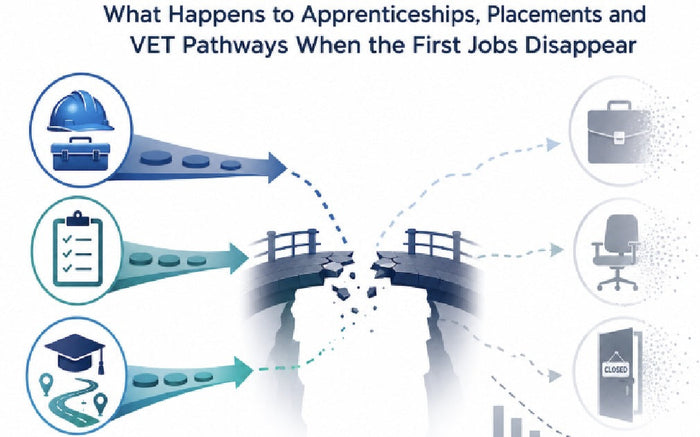
13 Jul 2026
Automating the Entry Level: What Happens to Apprenticeships, Placements and VET Pathways When the First Jobs Disappear
Youth unemployment has climbed to around 11 per cent, more than double the national rate, even as NCVER reports apprenticeship and traineeship commencements falling sharply since the pandemic-era subsidies were withdrawn and...
Read insight →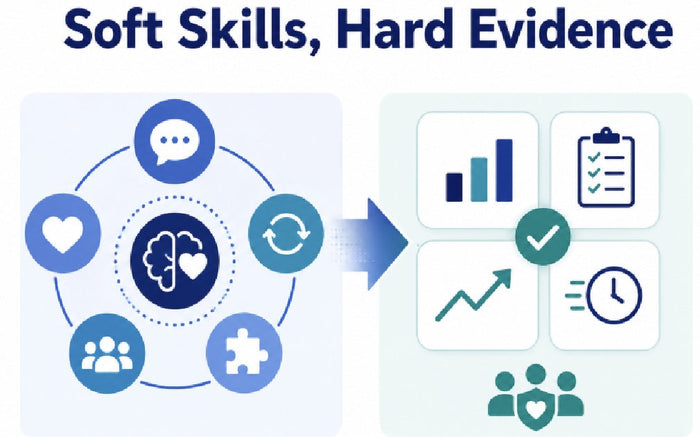
13 Jul 2026
Soft Skills, Hard Evidence: Why Communication, Adaptability and Emotional Intelligence Are Measurable Drivers of Employment, Productivity and Retention, Not Optional Extras
Nearly three in four VET qualification completers (73.1 per cent) undertake training for employment-related reasons, yet under a third end up working in the same occupation as their qualification, and the majority...
Read insight →
13 Jul 2026
Cross-Cultural Communication Is Not an Emerging Skill; It Is a VET Foundation: Why Australia's RTOs Are Already Ahead
An analysis of how Australia's vocational education and training system embedded cross-cultural capability into competency frameworks decades before the corporate world named it an emerging skill: the unit CHCDIV001 that has required...
Read insight →