
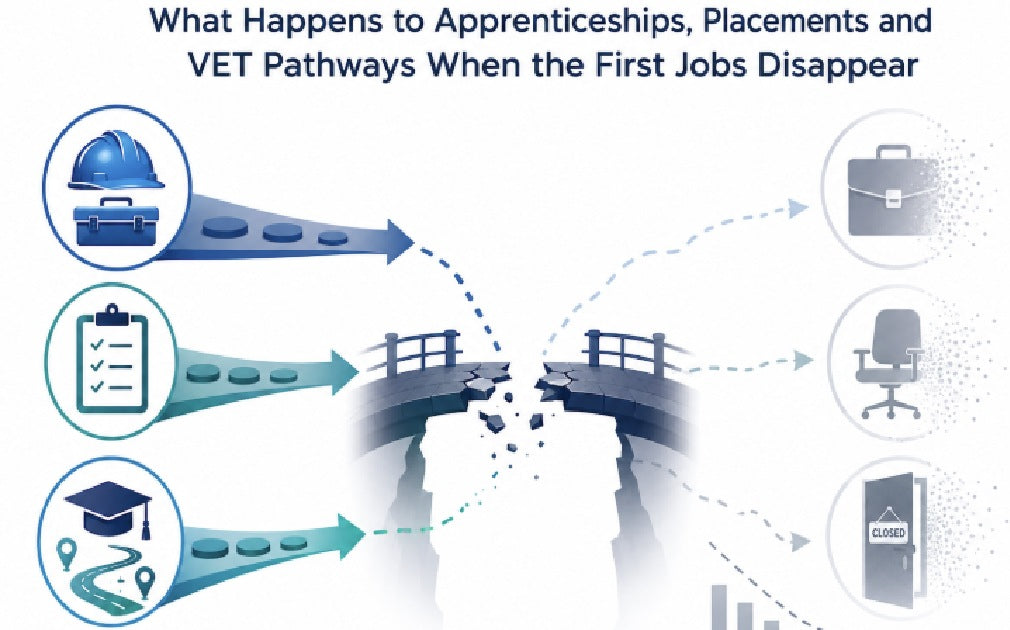
Youth unemployment has climbed to around 11 per cent, more than double the national rate, even as NCVER reports apprenticeship and traineeship commencements falling sharply since the pandemic-era subsidies were withdrawn and employers in technology and other sectors restructure their junior intake around automation. This article examines what the erosion of entry-level work means for apprenticeships, traineeships, work placement, and industry engagement obligations under the Standards for RTOs 2025, and what it means for RTOs, providers and the learners whose qualifications are built on work-based learning.
The First Rung Is Cracking
An observation that has circulated widely across professional networks, that artificial intelligence is eliminating entry-level positions faster than organisations can redesign their talent pipelines, struck a nerve because it named something many in workforce development had sensed but few had stated so plainly. The tasks that traditionally defined junior roles, the routine administrative work, the basic report preparation, the scripted customer inquiries, the data entry and the scheduling that gave new workers their first foothold in an organisation, are being absorbed by generative AI and automation at a pace that is outstripping the capacity of employers, educators and policymakers to respond.
For Australia's vocational education and training sector, this is not an abstract labour market trend. It is a structural challenge to the foundational mechanism through which VET delivers on its promise: work-based learning. Apprenticeships, traineeships and mandatory work placements depend on the existence of entry-level roles in which learners can develop, practise and demonstrate the competencies their qualifications require. If those roles are shrinking, transforming or disappearing in key industries, the entire architecture of work-based learning, and the VET pathways that depend on it, must be rethought.
This article sets out the evidence on what is happening to entry-level work, the implications for apprenticeships and work-based learning models, the obligations RTOs face under the Standards for RTOs 2025, and the practical strategies the sector will need so that VET pathways remain viable, equitable and genuinely connected to the workplaces of 2026 and beyond.
1. What Is Happening to Entry-Level Work: Erosion, Not Extinction
1.1 The Evidence: Reshaped, Not Vanished
The most accurate description of what is happening to entry-level work is erosion rather than extinction. Entry-level jobs are not vanishing overnight. They are being reshaped, with the routine, structured and predictable components of those roles, the very tasks that made them accessible to new workers, being progressively automated, while the more complex, relational and judgement-intensive components remain or grow. The result is not that there are no junior roles, but that the remaining junior roles demand a higher baseline of capability than they did five years ago, and that there are fewer of the purely routine positions that once served as the simplest entry point into employment.
The tasks most exposed to automation are precisely those that characterised traditional entry-level work: basic report preparation, routine customer inquiries, data entry, scheduling and simple administrative processing. A 2025 global youth survey, drawing on responses from more than 53,000 young people across 184 countries, warned that entry-level pathways are eroding fast, with frontline and junior roles particularly vulnerable and women and young workers at greatest risk of displacement.
In Australia, the signal is in the divergence between general and youth employment. The national unemployment rate has held around 4.5 per cent, but youth unemployment has remained elevated, reaching approximately 11 per cent by April 2026, according to the Australian Bureau of Statistics, more than double the national rate. When general employment is strong and youth employment is weak, the structural conditions for early-career entry are deteriorating. Jobs and Skills Australia's analysis of generative AI capacity reported cases in which large employers could see no clear business reason to take on junior engineers in the traditional way, because AI was already handling many of the structured, routine tasks those positions were built around. The same analysis warned that technology sectors may be among the first to restructure their entry-level intake entirely.
At the same time, the preparation pipeline for this new landscape is inadequate. Research from ADAPT found that only around 6 per cent of organisations mandate enterprise-wide AI training, which means the large majority of workers, and especially those in vulnerable groups and at early-career stages, are not being systematically upskilled to navigate the new task environment. Work is changing faster than the systems designed to prepare people for it.
The following table sets out the key indicators and what each one means for VET.
|
Indicator |
Evidence |
Implication for VET |
|
Youth unemployment elevated |
Youth unemployment reached approximately 11 per cent by April 2026 (ABS), more than double the national rate of around 4.5 per cent |
The first rung of the career ladder is weakening for young people, the core demographic for apprenticeships and traineeships |
|
Entry-level tasks are being automated |
Basic report preparation, routine customer inquiries, data entry and structured administrative tasks are increasingly replicated by generative AI and automation |
The tasks that traditionally gave apprentices and trainees their first workplace learning experiences are shrinking |
|
Employers are restructuring junior intake |
Some large employers report no clear business reason to take on junior engineers in the traditional way; technology may be among the first sectors to restructure entry-level hiring (JSA) |
The assumption that employers will always need entry-level workers in the same numbers and configurations is no longer safe |
|
Apprenticeship commencements declining |
NCVER reported trade commencements down approximately 17 per cent and non-trade commencements down approximately 25 per cent year on year in the September 2024 quarter, as wage subsidies were withdrawn |
VET's primary mechanism for work-based learning is cooling, and technology alone will not compensate for reduced employer demand |
|
AI training is not reaching workers |
Only around 6 per cent of organisations mandate enterprise-wide AI training (ADAPT); most workers, especially in vulnerable groups, are not being systematically upskilled |
Workers entering automated workplaces are not being prepared for the new task landscape, creating a readiness gap that VET must help close |
|
Global pathway erosion |
A 2025 survey of more than 53,000 young people across 184 countries warns that entry-level pathways are eroding fast, with frontline and junior roles particularly vulnerable |
This is not an Australian anomaly but a global structural shift that will reshape VET pathways across industries and occupational levels |
1.2 The Task Shift: From Routine to Judgement
Jobs and Skills Australia's generative AI analysis stresses that entry-level jobs may transform rather than simply diminish, with the human component of junior roles shifting toward monitoring, exception handling, human interaction and judgement. This is a critical insight for VET. It means the work-based learning experiences RTOs design must themselves shift: away from training learners on the routine tasks that AI already performs, and toward the higher-order human capabilities that are growing in importance even at entry level.
The following table illustrates this task shift and what it implies for what work-based learning should prioritise.
|
Tasks Declining (Increasingly Automated) |
Tasks Growing (Uniquely Human) |
|
Basic report preparation and document formatting |
Troubleshooting automated systems and handling exceptions |
|
Routine data entry and records management |
Managing complex client relationships and escalations |
|
Standard, scripted customer inquiry responses |
Exercising ethical judgement in ambiguous situations |
|
Manual scheduling and calendar coordination |
Cross-functional collaboration and stakeholder coordination |
|
Simple bookkeeping and invoice processing |
Interpreting AI outputs and verifying accuracy |
|
Repetitive, pattern-based quality inspection |
Training, mentoring and supporting team members through change |
For RTOs, the practical implication is direct. Workplace logbooks, placement assessment tasks and apprenticeship training plans must be redesigned around the tasks in the right-hand column, not the left. A trainee whose logbook is filled with entries about data entry, document formatting and routine scheduling is being trained for a workplace that is rapidly ceasing to exist. A trainee whose logbook documents troubleshooting of automated systems, management of complex client interactions and collaborative problem solving in cross-functional teams is being prepared for the workplace that is emerging.
|
The Core Dilemma |
|
Work is changing faster than early-career pathways. The routine tasks that once defined entry-level roles and that gave apprentices and trainees their first workplace learning experiences are being automated. VET's work-based learning architecture was built on the assumption that these roles would always exist in sufficient numbers and with sufficient substance to support genuine competency development. That assumption is no longer safe. |
2. Apprenticeships and Traineeships: The Cooling Market After the Subsidies
After the pandemic-era boom in apprenticeship numbers, driven in large part by generous government wage subsidies, the apprenticeship market cooled significantly once those subsidies were withdrawn. When the major employer wage subsidy under the Australian Apprenticeships Incentive System ended in mid-2024, NCVER reported sharp falls in commencements: in the September 2024 quarter, trade commencements were down by approximately 17 per cent and non-trade commencements by approximately 25 per cent compared with the same quarter a year earlier. In-training numbers remained above pre-pandemic levels, according to NCVER, but the direction of travel had clearly turned downward once the financial incentives were removed. This confirmed what many in the sector had long suspected: a significant portion of employer demand for apprentices during the pandemic period was subsidy-driven rather than organically sustained.
The Strategic Review of the Australian Apprenticeship Incentive System, whose final report, Skills for Tomorrow: Shaping the Future of Australian Apprenticeships, was released in early 2025, found that apprenticeship commencements and completion rates had been in decline since 2012 and made 34 recommendations to lift completions, improve support for women and other under-represented cohorts, and better align incentives with national priority occupations. The review signalled that the apprenticeship system is being redesigned for more targeted, higher-value pathways rather than the broad-based volume approach of the pandemic era. This is a significant policy shift. Incentives are likely to be more tightly focused on occupations where skills shortages are acute and where work-based learning delivers genuine, measurable outcomes, with increasing scrutiny on whether apprenticeships and traineeships produce real learning rather than cheap labour.
For RTOs, this creates a convergence of pressures. Automation is reducing the task content of many entry-level roles. Employer demand for apprentices and trainees is softening as subsidies are withdrawn. Policy is shifting toward quality over quantity. And the Standards for RTOs 2025 maintain strong expectations that training is industry-relevant, that industry engagement is ongoing, and that outcomes for learners and employers are demonstrably positive. The assumption that an RTO can always find a host employer willing to take on an entry-level worker and provide meaningful work-based learning is no longer safe. The sector needs new models.
3. Work-Based Learning Under the Standards for RTOs 2025: The Obligations Do Not Disappear
The Standards for RTOs 2025, in force since 1 July 2025, give providers more flexibility in how they meet quality expectations but maintain strong requirements around industry relevance, learner outcomes, and authentic training and assessment. Outcome Standard 1.1 requires that training aligns with training product requirements and reflects current industry practice. Outcome Standard 1.2 requires effective and ongoing engagement with industry, employer and community representatives to inform training design, delivery and assessment. ASQA's published material on the 2025 Standards clarifies that industry engagement should be ongoing to ensure training remains relevant, fit for purpose and reflective of current practice, while deliberately not prescribing a minimum number of engagements and instead placing responsibility on providers to choose appropriate strategies.
For apprenticeships, traineeships and placement-heavy qualifications, these requirements mean RTOs must still secure, supervise and document authentic work-based learning, even if entry-level roles are thinner, more automated or harder to source. Providers cannot simply drop work placement requirements without renegotiating the training product, and they cannot claim compliance with industry engagement obligations if their engagement does not grapple with the reality of how automation and AI are changing the tasks and capabilities that define the occupations their qualifications serve.
This last point deserves emphasis. Industry engagement under the 2025 Standards is increasingly a substantive obligation, not a procedural one. An RTO that engages with employers solely to confirm that its training package units still look familiar is not meeting the spirit of the Standards. The engagement must address what is actually happening in workplaces: which tasks are being automated, which human capabilities are growing in importance, what the real experience of junior workers looks like in an AI-augmented environment, and how training and assessment should adapt. If an employer reports that its entry-level roles now involve monitoring automated systems and handling exceptions rather than performing routine administrative tasks, the RTO must reflect that in its training and assessment strategy, its assessment tools and its work-based learning design.
|
Industry Engagement Is Now a Substantive Test |
|
Confirming that a training package unit still looks familiar is not industry engagement under the 2025 Standards. The real test is whether the RTO can describe which tasks in the target job roles are being automated, which human capabilities are growing, and how training and assessment have changed in response. Engagement that does not grapple with automation does not meet the spirit of Outcome Standard 1.2. The same logic flows into self-assurance: RTOs must be able to demonstrate, through evidence, that their work-based learning arrangements produce quality outcomes for learners and employers, including in sectors where entry-level roles are being restructured. |
4. Rethinking Work-Based Learning: Five Models for an Automated Landscape
The response to shrinking entry-level roles is not to abandon work-based learning but to diversify how and where it happens. Work-based learning remains the most powerful mechanism for developing the competencies that VET qualifications require, precisely because it places learners in conditions where they must apply their skills in real or realistic contexts, under the pressures and expectations of actual workplace performance. What must change is the assumption that work-based learning can only occur in traditional, long-duration, single-employer placements in roles that may no longer exist in their previous form.
The following table presents five models that RTOs can adopt, adapt and combine to maintain authentic workplace learning in an environment where traditional entry-level placements are becoming harder to source or less substantial in their learning content.
|
Model |
Description |
Strengths |
Limitations |
|
High-fidelity simulation |
VR and AR scenarios, digital twins and simulated workplaces replicating automated environments |
Scalable, repeatable, safe for practising high-risk tasks; accessible when real placements are scarce |
Cannot fully replicate workplace culture, interpersonal dynamics or unpredictable real-world conditions; must be supplemented with real exposure |
|
Shared and pooled placements |
Multiple employers share early-career workers through GTOs, industry clusters, or coordinated RTO and employer arrangements |
Distributes the hosting burden; exposes learners to diverse contexts; viable when individual employers cannot sustain a full placement |
Requires significant coordination; quality and consistency of the learning experience vary across employers; supervision can be fragmented |
|
Micro-internships and short WBL bursts |
Shorter, more frequent work experiences aligned to specific skill sets rather than long traditional placements |
Flexible and adaptive; can target specific AI-augmented tasks; easier for employers to offer in tight labour markets |
May lack the depth and continuity of longer placements; requires careful design to ensure sufficient evidence of competence across contexts |
|
Hybrid virtual and physical models |
Theory and some practical components delivered online through interactive modules; essential hands-on skills developed in workshops and on-site |
Widens access, reduces geographic barriers, lowers cost, and maintains quality through targeted physical components |
Requires strong digital infrastructure and learner support; risk of over-reliance on virtual components that do not build embodied skills |
|
Project-based employer partnerships |
Learners work, individually or in teams, on defined employer projects that address real business problems involving AI-augmented workflows |
Authentic, outcome-focused and directly valuable to employers; develops problem-solving and collaboration alongside technical skills |
Requires employers willing to invest time in briefing and mentoring; project outcomes may not cover all unit requirements |
No single model will be sufficient for all qualifications or all industries. The most resilient approach is a blended one: combining elements of simulation, micro-internships, employer project partnerships and traditional placement into a work-based learning strategy tailored to the specific occupation, the local labour market and the learner cohort. The Standards for RTOs 2025 provide the flexibility for this kind of innovation. The question is whether RTOs have the strategic capacity, the employer relationships and the assessment design capability to take advantage of it.
4.1 The Non-Negotiable: Real Workplace Exposure Must Remain
While diversified models are necessary, it is important to be clear about what cannot be replaced entirely. For many qualifications, particularly in trades, healthcare, aged care, community services and construction, real workplace exposure remains non-negotiable. A learner cannot acquire competence in welding, in administering medication, in managing a room of young children, or in operating heavy machinery in a virtual environment alone. High-fidelity simulation can prepare learners for these experiences and reduce the time they need in real workplaces, but it cannot substitute for them entirely. The Standards for RTOs 2025, training product requirements, and the Rules of Evidence all require that assessment evidence be valid, sufficient, authentic and current, and in many occupations, authenticity can only be established through performance in a real or closely supervised workplace.
The distinction RTOs must draw is between qualifications where the entire work-based learning component can be redesigned around alternative models, which may be possible in some administrative, business and technology qualifications, and qualifications where a core of real workplace exposure must be preserved while alternative models serve to supplement, extend and enrich that core. Making this distinction explicitly and documenting the rationale in the training and assessment strategy is itself a form of the self-assurance the 2025 Standards expect.
|
The Limit of Simulation |
|
A learner cannot acquire competence in welding, medication administration, early childhood practice or heavy machinery operation in a virtual environment alone. Simulation can prepare a learner and reduce time on site. It cannot manufacture authentic evidence. Where the Rules of Evidence require authenticity, a real or closely supervised workplace remains non-negotiable. |
5. Three Imperatives for RTOs: Tasks, Equity and Evidence
5.1 Re-Specify Workplace Tasks Around What Humans Still Do Best
Industry engagement under the 2025 Standards must now ask a question that was not necessary five years ago: which tasks in this qualification's target job roles are being automated, and which human tasks are growing in importance? The answers should directly reshape workplace logbooks, placement projects and assessment tasks. If employers report that their entry-level workers now spend more time troubleshooting automated systems than performing routine data entry, then the RTO's work-based learning design must reflect that reality.
This has consequences for training plan design in apprenticeships and traineeships. Rather than structuring workplace learning around a progression through routine tasks of increasing complexity, the traditional model, training plans should be structured around the human capabilities that remain essential: complex problem solving, client relationship management, ethical judgement in ambiguous situations, cross-functional collaboration, and the ability to interpret, verify and act on AI-generated outputs. These are the tasks that define the new entry level, and they are the tasks that work-based learning must prepare learners to perform.
5.2 Protect the Integrity and Equity of Work-Based Learning
Even if entry-level positions contract, ASQA's focus remains on the quality of outcomes and the integrity of training. Work-based learning must still give learners fair opportunities to demonstrate all aspects of competence, not just shadow an AI system or perform the diminished remnants of a once-substantial role. An apprentice who spends a placement watching an automated system process invoices while occasionally clicking an approval button is not receiving work-based learning of the quality or substance the Standards require.
The equity dimension is equally critical. Youth unemployment and the erosion of junior tasks disproportionately affect disadvantaged learners: young people from lower socioeconomic backgrounds, First Nations learners, learners from culturally and linguistically diverse backgrounds, and learners in regional and remote areas where employer options are already limited. VET pathways that rely on a "find your own placement" model will worsen these inequities if RTOs do not actively broker opportunities and support learners through the process. The Standards for RTOs 2025, with their emphasis on learner support and equitable access, reinforce the expectation that RTOs take greater responsibility for ensuring that all learners, not just those with pre-existing employer connections, can access meaningful work-based learning.
RTOs should also be embedding AI literacy, digital capability and adaptability into workplace preparation, so that learners arrive at placements equipped to add value in augmented workplaces. A learner who can work alongside AI tools, who understands how automated systems operate, and who can contribute to exception handling and quality assurance is a more attractive proposition for employers restructuring their junior roles around higher-value tasks. Preparing learners for the new entry level, rather than the old one, is both a quality imperative and an equity strategy.
5.3 Evidence Outcomes With Better Data
Jobs and Skills Australia's work on a national VET data asset is designed to track short-term and long-term outcomes after training, including employment, income and further study, allowing more nuanced analysis of which pathways and which providers actually deliver sustainable careers. Under an outcomes-based regulatory approach, RTOs that can demonstrate strong apprenticeship completion, employment outcomes and wage progression, even in disrupted sectors, will be better positioned with both ASQA and government funders.
This means RTOs must invest in systematic tracking of work-based learning outcomes: not just whether placements were completed, but what happened afterwards. Did the learner receive a job offer? Did they progress into higher-skill roles? Did employers report satisfaction with the learner's capabilities? Did the learner report that the placement prepared them for the realities of the occupation? These data points should feed directly into the RTO's self-assurance processes and continuous improvement. In a regulatory environment that increasingly measures providers by the quality of their outcomes rather than the completeness of their paperwork, the RTOs that can show genuine, sustained employment outcomes from their work-based learning programs will hold a significant competitive and compliance advantage.
|
The Verdict |
|
The first rung of the career ladder is not being removed so much as raised. RTOs that redesign work-based learning around the human tasks automation cannot perform, that broker placements actively rather than leaving learners to find their own, and that track outcomes rather than paperwork will meet both the letter and the intent of the 2025 Standards. Those who wait for the old entry-level role to return will be training learners for a workplace that no longer exists. |
6. Conclusion: Innovate, Do Not Retreat
The question now circulating across professional networks, what happens when entry-level jobs disappear, is not a hypothetical for VET. It is an operational reality already affecting apprenticeship numbers, placement availability, employer engagement and the substance of work-based learning across multiple industries. The evidence is consistent: youth unemployment is elevated, entry-level tasks are being automated, apprenticeship commencements have declined as subsidies ended, employers in key sectors are restructuring their junior intake, and the majority of organisations are not yet preparing their existing workers, let alone their new hires, for an AI-augmented task environment.
The response from VET must be to innovate, not retreat. Work-based learning remains the most effective mechanism for developing genuine workplace competence, and the Standards for RTOs 2025 provide the flexibility for RTOs to design models that are resilient to disruption in the entry-level labour market. High-fidelity simulation, shared and pooled placements, micro-internships, hybrid virtual and physical models, and project-based employer partnerships are all viable strategies that can complement and extend traditional placement.
But innovation must be accompanied by discipline. The new models must still produce assessment evidence that is valid, sufficient, authentic and current. Industry engagement must genuinely grapple with how automation is changing the occupations that qualifications serve. And work-based learning must be redesigned around the tasks, capabilities and relationships that automation cannot replace: complex problem solving, ethical judgement, human interaction, and the capacity to work alongside AI systems as a competent, critical and capable professional. The first rung of the career ladder is cracking. VET's job is not to pretend it is still solid. It is to build the next one.
|
Summary: Rebuilding the First Rung Under the 2025 Standards |
|
1. Audit current work-based learning arrangements. Are placement tasks still substantive, or have they been hollowed out by automation? Update logbooks and assessment tasks accordingly. 2. Diversify work-based learning models. Adopt simulation, micro-internships, pooled placements and project-based partnerships as supplements to traditional placement, particularly where entry-level roles are shrinking. 3. Redesign training plans around human tasks. Structure workplace learning around problem solving, client management, exception handling and ethical judgement, not the routine tasks AI already performs. 4. Strengthen industry engagement. Ask employers directly how automation is changing junior roles and what capabilities they now need, and document this in the training and assessment strategy. 5. Actively broker placements. Do not rely on a "find your own placement" model. Take responsibility for sourcing and supporting work-based learning, especially for disadvantaged learners. 6. Embed AI literacy in workplace preparation. Ensure learners arrive at placements equipped to work alongside automated systems and add value in augmented workplaces. 7. Track outcomes systematically. Monitor placement completion, job offers, role progression and employer satisfaction as core self-assurance metrics under the 2025 Standards. 8. Preserve real workplace exposure where it is non-negotiable. Distinguish between qualifications where alternative models can fully replace traditional placement and those where a core of real workplace experience must be maintained. 9. Document the rationale. Record in the training and assessment strategy which qualifications can move to alternative models and which must retain real workplace exposure, treating that decision itself as evidence of self-assurance. 10. Treat the shift as both a quality and an equity imperative. Prepare learners for the new entry level, not the old one, so that disadvantaged cohorts are not the ones left behind. |
References and Further Reading
Australian Bureau of Statistics (2026). Labour Force, Australia, April 2026. https://www.abs.gov.au/statistics/labour/employment-and-unemployment/labour-force-australia/latest-release
Australian Computer Society, Information Age (2025). Australian Firms Reduce Entry-Level Engineering Hiring as AI Absorbs Routine Tasks. https://ia.acs.org.au
Australian Skills Quality Authority (2025). 2025 Standards for RTOs Commence. https://www.asqa.gov.au/news-events/news/2025-standards-rtos-commence
ADAPT (2025). AI and Australia's Entry-Level Jobs: Women and Young Workers Most Exposed. https://adapt.com.au
Department of Employment and Workplace Relations (2025). Skills for Tomorrow: Shaping the Future of Australian Apprenticeships (Strategic Review of the Australian Apprenticeship Incentive System, Final Report). https://www.dewr.gov.au/australian-apprenticeships/resources/strategic-review-australian-apprenticeship-incentive-system-final-report
Department of Employment and Workplace Relations (2025). Revised Standards for RTOs: Frequently Asked Questions. https://www.dewr.gov.au/standards-for-rtos/revised-standards-rtos-frequently-asked-questions
Jobs and Skills Australia (2025). Generative AI: Augment and Advance the Way We Work in Australia. https://www.jobsandskills.gov.au
Jobs and Skills Australia (2024). Strong and Responsive VET Pathways (Technical Paper). https://www.jobsandskills.gov.au
National Centre for Vocational Education Research (2025). Apprentices and Trainees 2024: September Quarter. https://www.ncver.edu.au
WA Government (2025). Training Within the 2025 Standards (Fact Sheet). https://www.wa.gov.au