
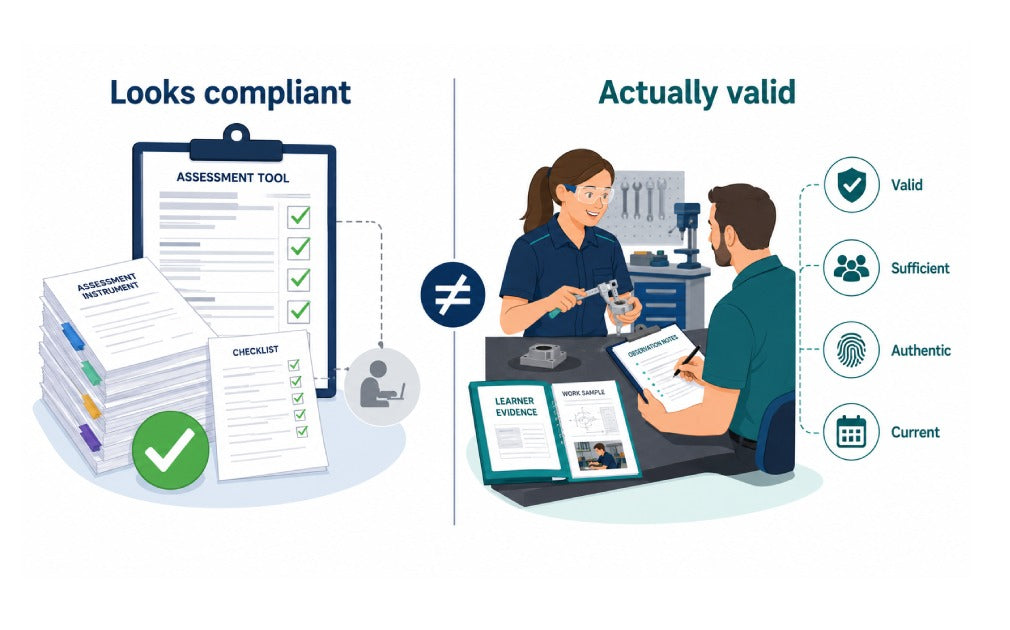
Standard 1.4(2)(b) of the 2025 Outcome Standards for Registered Training Organisations requires every assessment judgement in Australian VET to be justified against four specific rules of evidence: validity, sufficiency, authenticity and currency. Standard 1.3(2)(b) requires every assessment tool to be reviewed before use to confirm it can produce evidence consistent with those rules. Yet experienced validators and compliance managers continue to encounter tools that look substantial, professionally branded, heavily contextualised and supported by elaborate mapping, while failing to gather the evidence the unit actually requires. The tool assesses an activity rather than a competency. It is contextualised but not aligned. It is reassuring on the surface and hollow underneath. This article examines why that pattern persists across the sector, where it does the most damage, and what Standard 1.4 actually requires an assessment tool to prove.
In the Australian vocational education and training sector, there is a frustrating pattern that experienced trainers, assessors, validators, and compliance managers encounter again and again. An assessment tool may look substantial. It may be well laid out, professionally branded, heavily contextualised and supported by mapping, model answers and observation documents. At first glance, it appears serious. Yet when someone reads it properly against the unit of competency, a different truth emerges. The task does not really assess what the unit is asking for. It may be related in theme. It may be workplace-flavoured. It may even be educationally useful. But it misses the point of the unit.
This is one of the most persistent assessment quality problems in Australian VET. It is not always caused by laziness or neglect. In many cases, the people writing the tools are trying to be practical, contextualised and useful. They are trying to give learners meaningful activities. They are trying to create something that resembles real work. They may even believe they are doing a strong job because the assessment feels realistic and looks comprehensive. But somewhere in the process, the core purpose of assessment is lost. The task becomes an activity rather than a valid evidence-gathering instrument. It becomes something learners do rather than something assessors can use to make a defensible judgement of competence.
That distinction is where much of the sector's difficulty begins. And it is a distinction that the 2025 Outcome Standards now make unavoidable.
What Standard 1.4 actually requires of every assessment judgement
The Outcome Standards do not leave assessment validity to professional preference. They define it. Standard 1.4(2)(b) of the National Vocational Education and Training Regulator (Outcome Standards for NVR Registered Training Organisations) Instrument 2025, which took effect on 14 March 2025, requires assessors to make individual assessment judgements that are justified against four rules of evidence. Those rules are named in the instrument itself.
Validity, as defined in Standard 1.4(2)(b)(i), means that the assessment evidence is adequate such that the assessor can be reasonably assured that the VET student possesses the skills and knowledge described in the training product. That is not a loose standard. It is a test that the tool must be able to pass. If the evidence being gathered does not give the assessor a reasonable basis to conclude that the learner holds the specific skills and knowledge the unit describes, validity is not satisfied. A task that generates impressive-looking output but fails to elicit the particular performance the unit calls for is, by the words of the instrument, not producing valid evidence.
Sufficiency, under Standard 1.4(2)(b)(ii), requires the quality, quantity and relevance of the assessment evidence to enable the assessor to make an informed judgement of the student's competency in the skills and knowledge described in the training product. Sufficiency is not solved by making the task longer. It is not solved by adding more activities. It is solved by gathering evidence that is genuinely relevant to the requirements the unit sets. A portfolio of thirty pages can still be insufficient if most of those pages do not address the performance evidence the unit mandates. Conversely, a tightly designed observation can be sufficient because the evidence is directly on point.
Authenticity, under Standard 1.4(2)(b)(iii), requires the assessor to be assured that the student's assessment evidence is the original and genuine work of that student. Currency, under Standard 1.4(2)(b)(iv), requires the evidence to document and demonstrate the student's current skills and knowledge. These are not administrative tests. They are definitional. The instrument has told the sector, in direct language, what an assessment judgement has to rest on. An assessment tool that cannot support judgments meeting all four tests is not yet a valid assessment tool, no matter how professionally it is presented.
Standard 1.3(2)(b) then closes the loop. It requires assessment tools to be reviewed before use to ensure assessment can be conducted in a way that is consistent with the principles of assessment and rules of evidence set out under Standard 1.4. This is a pre-delivery obligation. It does not say tools must be reviewed at some future point or during the next validation cycle. It says they must be reviewed before they are used. Standard 1.3(2)(c) requires the outcomes of those reviews to inform any necessary changes. When tools that do not meet the rules of evidence are nonetheless placed in front of students, the failure is not only pedagogical. It is regulatory.
The deeper problem: activity design is not assessment design
There is a major difference between writing an activity and designing an assessment. An activity is something a learner completes. It may be interesting, relevant, engaging or practical. It may build knowledge, develop confidence or create workplace familiarity. All of that can be valuable. But an assessment has a narrower and more demanding purpose. It must generate evidence that allows the assessor to determine whether the learner has met the actual requirements of the unit of competency. That means the task must be designed around evidence, not just around usefulness or realism. It must ask the learner to do, demonstrate, explain or produce exactly the kinds of things that will establish competence in a defensible way.
Too many assessment tools in the sector are built the other way around. Someone starts with a good-looking activity, usually one that feels practical or operationally relevant, and then tries to map the unit to it afterwards. The task might involve developing a workplace policy, completing a project, responding to a scenario, compiling a portfolio, adapting a business document or writing a report. These tasks can look impressive. They can feel authentic. But if they were not designed from the unit outward, there is a serious risk that they will never truly assess what the unit requires. They may touch on some aspects of the unit. They may create the impression of coverage. Yet the actual evidence gathered remains incomplete, indirect or too vague to support a proper judgement.
This is why so many tools miss the point. They begin from the wrong question. Instead of asking what evidence this unit requires and how it will be collected, the designer often asks what a useful or realistic task the learner can be given. The first question produces an assessment. The second produces activity. Both may look similar on the surface, but they are not the same thing at all. And under the 2025 Standards, only the first question produces tools that can satisfy Standard 1.4.
When contextualisation becomes a disguise for misalignment
The confusion becomes worse when contextualisation is misunderstood. Contextualisation is essential in VET. Learners must encounter assessment tasks that make sense in workplace or industry settings. Providers must adapt materials so they are relevant, accessible and connected to real practice. Standard 1.4(2)(a)(ii) itself names flexibility as a principle of assessment, requiring assessment to be appropriate to the context, training product and VET student. Contextualisation is not merely permitted. It is required. But it is not a licence to drift away from the evidence requirements of the unit. It is not a substitute for validity. A task can be beautifully contextualised and still fail completely as an assessment if it does not gather the evidence the unit actually requires.
This is a mistake the sector makes repeatedly. A task is praised because it is practical, industry-based or aligned to business documents and local operations. Those features are treated as proof of quality. Yet when the tool is examined carefully, the learner is not actually being asked to demonstrate the performance criteria in a reliable way. The knowledge evidence is barely touched. The performance evidence is assumed rather than captured. Observation requirements are weak or generic. The mapping is generous, but the task itself does not do the work the mapping claims. In those moments, contextualisation becomes a disguise for misalignment.
This matters because many people in VET have been taught, implicitly or explicitly, to equate contextualisation with strength. They see a task that feels real-world and assume it must therefore be sound. But real-world flavour is not enough. Practicality is not enough. Relevance is not enough. Good assessment must be contextualised, but it must also be valid, evidence-led and aligned to the unit. When one of those elements is missing, the task may still be useful for learning, but it is no longer functioning properly as an assessment.
Why educationally interesting is not the same as evidentially necessary
Another reason assessment tools miss the point is the widespread habit of designing around what feels educationally interesting rather than what is evidentially necessary. This is understandable. People who care about learning want tasks that feel meaningful. They want students to think, engage, create and solve problems. They want learning experiences that look and feel richer than narrow compliance exercises. That instinct is often a good one in teaching. But assessment is not an unrestricted educational canvas. It has to answer a specific question with a statutory definition attached. Has the learner produced evidence that is valid, sufficient, authentic and current in the precise sense that Standard 1.4 requires?
This means some tasks that are excellent learning activities may still be weak assessment tasks. A reflective journal may help a learner think more deeply about workplace issues, but it may not prove competent performance. A policy-writing exercise may build understanding of organisational systems, but it may not assess the required practical application of the unit. A discussion task may stimulate thinking, but not generate enough observable evidence. A portfolio may look substantial, but still miss critical performance requirements. None of these tasks is necessarily useless. The problem is treating educational usefulness as if it automatically equals assessment validity.
The VET sector has been too slow to confront this distinction honestly. In many cases, the tool looks busy enough, substantial enough and professionally enough written that nobody wants to admit it is not actually assessing the unit properly. That is where weak assessment survives. It survives inside tasks that are plausible, attractive and broadly relevant, but not aligned at the level that matters. Standard 1.3's pre-use review obligation exists precisely to catch these tools before they reach students. Where that review is superficial, the tool moves into delivery, and the evidence gap becomes embedded in completed assessments across multiple cohorts.
How clustering accelerates evidence drift
Clustering adds another layer of difficulty. Clustered assessment can be efficient, integrated and realistic when done well. But it can also be one of the fastest ways for assessment to lose its centre. Once a provider decides that one activity or project will cover several units, the temptation to overclaim becomes very strong. The task is designed around a broad workplace scenario, and then every unit requirement is retrospectively linked to it through a mapping document. On paper, the cluster looks comprehensive. In reality, some of the units may be barely assessed at all. The task is doing too much conceptually and not enough evidentially.
This is one reason so many clustered tools feel confusing when reviewed carefully. They are not built around distinct competency requirements. They are built around a broad piece of work that someone hopes will be sufficient. Then the mapping stretches to fill the gap. The result is not an integrated assessment. It is often evidence drift. The cluster becomes a container into which too many claims are placed, and too little real proof is gathered. Under the sufficiency rule in Standard 1.4(2)(b)(ii), a cluster that gathers a substantial quantity of evidence but lacks relevance to some of the units it claims to cover is, by the words of the instrument, not producing sufficient evidence for those units. Volume is not the test. Relevance is. And the relevance must be demonstrable for each unit the cluster claims to assess.
When mapping becomes an act of optimism
Weak mapping reinforces all of this. Once a task has been written, mapping is often used to make the tool appear stronger than it really is. Every performance criterion is linked somewhere. Knowledge evidence is claimed because the topic seems related. Performance evidence is assumed because the learner is completing a substantial-looking activity. But strong mapping must not be an act of optimism. It must be an honest account of where the evidence actually sits. If the learner is not clearly required to demonstrate something, the mapping must not claim that it is covered. Too often, however, mapping is used to rescue a task that was never well designed in the first place.
This is why poor assessment tools can look so convincing. They are supported by layers of documentation that signal completeness. There is a task. There are instructions. There are model answers. There is a checklist. There is a mapping matrix. There may even be a validation record. To a time-poor manager or a non-specialist reviewer, this all feels reassuring. But if the task itself is disconnected from the actual intent of the unit, none of the surrounding paperwork fixes that. It simply makes the weakness harder to see. Standard 1.4 is indifferent to the volume of documentation. It asks whether each individual assessment judgement can be justified against four specific rules. If the mapping is doing the argumentative work that the task itself should be doing, the tool is not compliant. It is decorated.
The intent of the unit, and why writers embed their own priorities instead
The intent of the unit is especially important here. Units of competency are not random topic lists. They describe particular forms of performance, knowledge and application in a competency-based framework. The goal is not for the learner to do something vaguely related to the field. The goal is for the learner to demonstrate the capability described by the unit. When tools miss that intent, they begin assessing what the writer values rather than what the unit requires. A person may think a policy-writing task is highly important. Another may think document control is central. Another may be passionate about business reports or file management protocols. Those may all matter in a workplace, but unless they are the right evidence for the unit in question, they do not belong at the centre of the assessment.
This is one of the greatest hidden risks in assessment development. Writers often embed their own sense of what is important rather than the actual competency demands of the training package. The result is an assessment that is highly contextualised to the writer's beliefs, the organisation's habits or the provider's preferences, but weakly aligned to the unit. Because the tool still looks structured and practical, the flaw can be missed for years. The validity rule in Standard 1.4(2)(b)(i) does not bend to authorial preference. It requires evidence that the student possesses the skills and knowledge described in the training product, not the skills and knowledge the writer finds most interesting, most familiar, or most convenient to assess.
Where validation fails to catch the problem
The problem is not helped by weak review processes. In a strong system, validation must catch this. A good validator must be asking what the learner is explicitly required to do, what evidence is actually being produced, whether the assessor can reliably judge competence, and whether the task aligns with the intent of the unit. But where validation is superficial, polite or overly focused on formatting, these questions never get asked deeply enough. The review process becomes a paper exercise. The tool is signed off. The provider becomes more confident. The underlying problem remains.
Standard 1.5 now makes the stakes of that failure regulatory. It requires the assessment system to be quality assured by appropriately skilled and credentialled persons through a regular process of validating assessment practices and judgments. Validation must ensure that the assessment system produces judgments consistent with the training product and compliant with the instrument. The outcome of an assessment validation must not be solely determined by a person who designed or delivered the training or assessment. Every training product on scope must be validated no less often than once every five years, and more frequently where risks to training outcomes, changes to the training product or relevant feedback warrant it. A validation that signs off on a tool failing the rules of evidence in Standard 1.4 is not a compliant validation. It is a validation in name only.
This has real consequences. Learners may complete lengthy and complex tasks that do not actually prove competence. Assessors may make judgments on inadequate evidence. Providers may believe they are compliant when they are not. Later reviewers may have to explain that a tool presented as robust does not cover the unit at all in any meaningful sense. That creates frustration, cost and loss of trust. It also contributes to one of the most demoralising experiences in VET quality work: discovering that something which looks strong on the surface is hollow underneath. Under Standard 4.4's continuous improvement obligation, those discoveries must feed back into the assessment system. Where they do not, the same flawed tool continues to produce flawed judgments across further cohorts of learners.
Where the reset must start: reading the unit properly, before anything else
The sector, therefore, needs a reset in how it thinks about assessment development. The starting point must always be the unit of competency, read properly and understood at the evidence level. What does the learner have to demonstrate? What must the assessor be able to observe, verify or judge? What knowledge must be shown, and how should that knowledge be evidenced? What kind of task design will produce that evidence in a valid, fair and practical way? These questions are less glamorous than designing a nice-looking activity, but they are where real assessment quality begins. They are also the questions Standard 1.3's pre-use review is designed to answer, in the words of the instrument itself.
The sector must also become better at distinguishing between learning and assessment. Good tools can support both, but they do not do so in the same way. Some activities belong in training, discussion, practice or preparation rather than summative judgement. Not every useful task should become an assessment task. This is a discipline issue as much as a design issue. Writers must resist the urge to turn every educationally appealing activity into evidence of competence. The pressure to do so is genuine, because writers want their work to be used. But the discipline required is equally genuine, because Standard 1.4 does not have a clause that excuses well-intentioned misalignment.
What a more rigorous assessment culture would look like in practice
Trainers, assessors, validators and compliance managers all have a role to play in shifting this culture. Trainers must look beyond whether a task feels engaging and ask whether it produces the right evidence. Assessors must resist making broad judgements where the task has not clearly elicited the required performance. Validators must challenge tasks that are context-rich but evidence-poor, and must hold that challenge even when the tool is already in use. Compliance managers must stop being reassured by bulky packs and mapping tables and start focusing on the actual evidentiary logic of the tool. Leaders must understand that assessment quality is not proven by presentation. It is proved by alignment.
Stronger exemplars would help as well. Many practitioners have seen too many mediocre tools and too few genuinely strong ones. That distorts their sense of what normal looks like. If weak tools are widespread enough, they begin to feel acceptable simply because they are familiar. Better examples of evidence-led design, well-structured assessment and honest mapping would help recalibrate the sector. So would more serious professional development focused not on generic compliance talk, but on the craft of designing assessments that capture competency. The Credential Policy now requires specified credentials for those designing, delivering, assessing and validating assessments. The framework is in place. The capability to use it well is the remaining variable.
The good news is that this problem can be improved. Unlike some structural issues in VET, this is not beyond the sector's control. It requires sharper design, stronger reading of units, better validation, more honest mapping and a more disciplined understanding of what assessment is for. It also requires the courage to say, when necessary, that a task may be useful, interesting and practical while still being the wrong assessment for the unit.
That honesty is essential. Because until the sector becomes better at recognising the difference between a good activity and a valid assessment, it will keep producing tools that look right, feel right and miss the point entirely.
Standard 1.4 has told the sector what valid assessment evidence actually is. Standard 1.3 has told the sector when the check for valid evidence must happen. Standard 1.5 has told the sector who must conduct that check and how often. The instruments have done their work. What remains is the sector's willingness to build tools that answer those standards with the same precision that the standards themselves use.
In a competency-based system, missing the point is not a small flaw. It is the flaw.
Primary legislative and policy sources referenced
National Vocational Education and Training Regulator (Outcome Standards for NVR Registered Training Organisations) Instrument 2025, effective 14 March 2025, Standards 1.3, 1.4 and 1.5.
Standard 1.4(2)(a), four principles of assessment: fairness, flexibility, validity and reliability.
Standard 1.4(2)(b), four rules of evidence: validity, sufficiency, authenticity and currency, as defined in the instrument.
Standard 1.3(2)(b) and (c), assessment tools are reviewed prior to use and outcomes of reviews inform changes.
Standard 1.5, five-year validation cycle, risk-based approach, and independent validator rule.
Credential Policy, Revised Standards for RTOs, Department of Employment and Workplace Relations.
Standard 4.4, systematic monitoring and evaluation feed continuous improvement.