
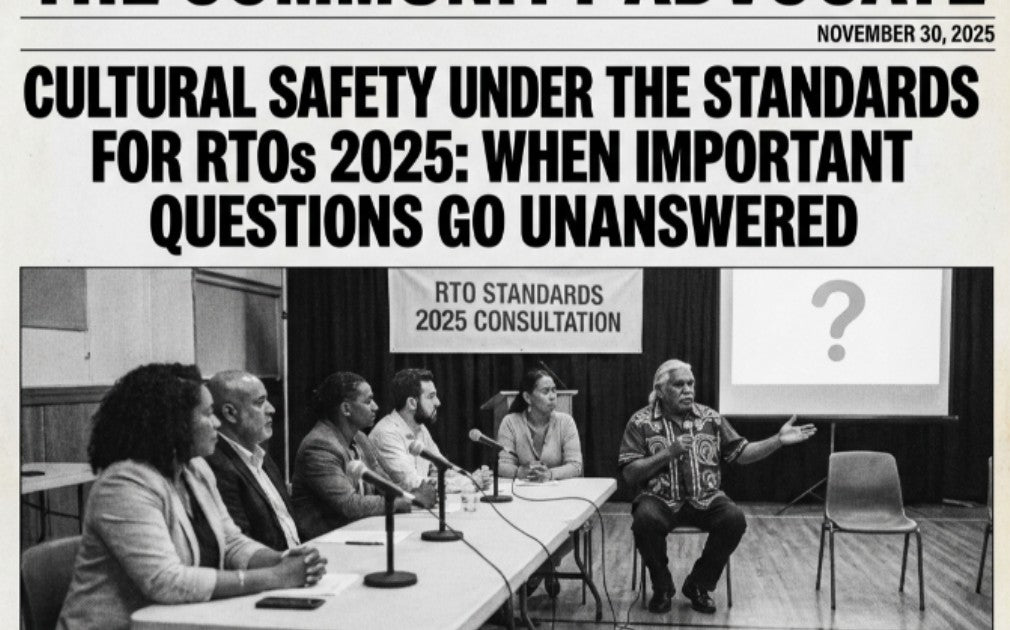
At the recent ASQA 2025 Standards Insights webinar, a colleague of mine, Anissa Jones, asked a set of pointed, thoughtful questions about diversity, inclusion and cultural safety in the new Standards for RTOs.
Her questions were not fringe or technical.
They went directly to the heart of Quality Area 2 and to Standard 2.5, which is meant to ensure that the learning environment promotes and supports the diversity of VET students, and specifically that it is culturally safe for First Nations people.Legislation-SRTOs
Yet her questions were not answered.
That silence matters.
If a First Nations expert, who is a PhD candidate in Aboriginal policy and perspectives in VET, raises concerns about how cultural safety is being framed, measured and reported, and those questions are left hanging, it tells us something uncomfortable about who is being centred in this conversation and who is not.
This article is my attempt to unpack why her questions are so important, what the legislation actually requires, and why the sector should not accept vague assurances about “improvements” in diversity and inclusion without transparent evidence and First Nations leadership.
The questions that were asked, and the answers that never came
During the webinar, ASQA indicated that since 1 July 2025, there had been “improvement” in diversity and inclusion outcomes. That sounds reassuring on the surface. However, when Anissa asked for the basis of that claim, she received no response.
Her questions were straightforward:
-
Where is the data that shows diversity and inclusion have improved?
-
How is ASQA differentiating between Standard 2.5(2)(a), which deals with a safe and inclusive environment for all VET students, and Standard 2.5(2)(b), which specifically requires a culturally safe environment for First Nations people?
-
Where are the voices of Aboriginal and Torres Strait Islander peoples in confirming that any “improvement” has actually been achieved?
These are not hostile questions. They are exactly the kind of questions ASQA itself would expect an RTO to answer if the RTO claimed to be meeting Standard 2.5.
If an RTO said “our diversity and inclusion have improved”, ASQA would ask:
-
What evidence do you have?
-
How do you know First Nations learners feel culturally safe?
-
What changes have you made to your environment, policies and practices as a result of feedback and complaints?
It is entirely reasonable for sector leaders to expect the same standard of evidence and transparency from the regulator that the regulator expects from RTOs.
What the legislation actually requires on diversity and cultural safety
To appreciate the significance of these questions, we need to go back to the text of the Outcome Standards.
Part 2 of the National Vocational Education and Training Regulator (Outcome Standards for NVR Registered Training Organisations) Instrument 2025 deals with VET student support. It makes the overarching requirement clear: VET students are to be treated fairly and properly informed, supported and protected.Legislation-SRTOs
Within this Part, Standard 2.5 is the core diversity and inclusion provision. In the instrument itself, Standard 2.5 establishes the following Outcome Standard:
“The learning environment promotes and supports the diversity of VET students.”Legislation-SRTOs
The performance indicators then require that an NVR RTO demonstrate two distinct things:
-
It fosters a safe and inclusive learning environment for VET students.
-
It fosters a culturally safe learning environment for First Nations people.Legislation-SRTOs
The Explanatory Statement reinforces this. It explains that Standard 2.5 is intended to ensure RTOs actively create a safe and inclusive environment that is free from racism, discrimination and harassment, and that they actively consider how recruitment, training environments, activities, assessment processes and wellbeing supports are accessible and inclusive for diverse student cohorts.Legislation-SRTOs
It then goes further. In the discussion of paragraphs 79 to 83, the Explanatory Statement states that:
-
Particular attention must be given to ensuring that the learning environment is culturally safe for First Nations people.
-
This involves acknowledging the unique experience of First Nations people in Australia.
-
It recognises that First Nations learners do not always have the same level of access to VET as non-Indigenous Australians, nor the same positive experiences.
-
It explicitly calls for active measures to address unconscious bias, racism and discrimination, and to support self-determination for First Nations people.Legislation-SRTOs
Crucially, the Explanatory Statement also confirms that the obligation to foster a culturally safe environment for First Nations people applies to all NVR RTOs, even where no students have currently been identified as First Nations.Legislation-SRTOs
In other words, cultural safety is not optional, and it is not dependent on whether an RTO can see First Nations learners in its current enrolment profile. It is a standing obligation.
Given that clarity in the legislation, claiming “improvement” in diversity and inclusion without explaining how cultural safety for First Nations people is being measured and verified is not consistent with the intent of Standard 2.5 itself.
Outcome standards, “effectiveness”, and the risk of vague assurances
The Explanatory Statement for the Outcome Standards explains that the move from the 2015 Standards to the 2025 framework is intended to shift the sector from binary, prescriptive compliance toward continuous improvement in quality and integrity. Rather than ticking boxes, RTOs are expected to demonstrate that they are effectively achieving the outcomes specified in each Standard.Legislation-SRTOs
The document notes that adverbs like “effectively” are used deliberately to push organisations beyond bare minimum compliance and to encourage genuine quality, innovation and responsiveness to student needs.Legislation-SRTOs
This sounds positive. However, it also introduces risk. If terms like “effectively” and “improvement” are not anchored in transparent evidence and the lived experiences of those who are meant to benefit, they can become empty phrases that mask ongoing harm.
In the context of Standard 2.5, saying that diversity and inclusion have “improved” only has meaning if:
-
There is clear, disaggregated evidence showing better outcomes and experiences for Aboriginal and Torres Strait Islander learners and staff; and
-
First Nations communities themselves confirm that the environment feels safer, fairer and more respectful than before.
If those elements are absent, “improvement” risks becoming a story told by institutions about themselves, rather than a reality experienced by the people most affected.
This is exactly why my colleague’s unanswered questions are so important.
Cultural safety is not the same thing as general diversity.
One of the subtle problems in the way these issues are sometimes discussed is a tendency to roll everything into a generic “diversity and inclusion” banner. That approach erases the very distinction that Standard 2.5 consciously draws between the general obligation to foster a safe and inclusive environment for all students and the specific obligation to foster a culturally safe environment for First Nations people.
Cultural safety has a particular history and meaning in Australia. It is about much more than representation, festivals or symbolic acknowledgement. It is about power, history, identity, and the freedom for Aboriginal and Torres Strait Islander people to learn and work without having their identity questioned, their experience minimised or their safety compromised.
The Explanatory Statement makes this explicit. It states that the intent of Standard 2.5 is to create environments where student diversity is valued and accommodated, and it highlights the need to actively address unconscious bias, racism and discrimination, and to support self-determination for First Nations people.Legislation-SRTOs
That means cultural safety cannot be reduced to:
-
a policy document that mentions First Nations learners;
-
an acknowledgement at the start of class; or
-
a single professional development session on “cultural awareness”.
Cultural safety shows up in whether First Nations learners feel safe to speak up when something is wrong, whether teaching materials avoid deficit narratives and stereotypes, whether staff understand the impact of intergenerational trauma and systemic racism, and whether complaints about racism are taken seriously and lead to change.
If an RTO has colourful posters and a reconciliation statement on its website, but First Nations students still feel that raising concerns will make them a “problem”, then the environment is not culturally safe, regardless of how diverse the enrolment figures look.
The same logic applies to the regulator. If Aboriginal experts ask direct questions about how cultural safety is being measured and those questions are left unanswered, it sends a message about whose voices are prioritised when the story of “improvement” is told.
Who gets to decide whether cultural safety has improved?
Another critical issue raised by Anissa and reinforced by colleagues such as Arit Mangal is the question of who is considered qualified to judge whether Outcome 2.5 has been achieved.
The Outcome Standards themselves speak to expertise and lived understanding in several places. Standard 3.3, for example, requires that those delivering training and assessment have industry competencies, skills and knowledge relevant to the training product and a practical understanding of current industry practices.Legislation-SRTOs
Validation requirements in Standard 1.5 similarly insist that assessment validation must be undertaken by people who collectively have relevant industry competencies, current industry understanding and appropriate credentials, and that the outcome of validation cannot be determined solely by the person who designed or delivered the assessment.Legislation-SRTOs
The logic is simple. You cannot credibly judge the quality of training or assessment in a specialist domain if you do not have appropriate expertise and a lived understanding of that domain.
The same logic should apply to cultural safety. If the regulator is claiming that cultural safety has improved under Standard 2.5(2)(b), the sector is entitled to ask:
-
How many Aboriginal and Torres Strait Islander staff are in roles that shape audit frameworks, policy, guidance and enforcement?
-
How are Aboriginal and Torres Strait Islander communities and organisations involved in the design and validation of the indicators used to assess cultural safety?
-
When ASQA conducts audits where cultural safety is in scope, are First Nations experts involved in those audits in a substantive way, not just as external commentators after the fact?
If the answer to those questions is that First Nations participation is minimal or indirect, then claims about cultural safety being “effectively” delivered risk reproducing the very colonial dynamic that Anissa has highlighted - a system in which non-Indigenous discomfort can remove a clause on cultural safety from a governance section, while First Nations questions in a webinar go unanswered.
Where is the data, and what should it look like?
The Outcome Standards do not sit in isolation. They sit alongside data and reporting frameworks that require RTOs to provide information about their performance. The Explanatory Statement emphasises that the new framework is intended to drive continuous improvement, including through the use of feedback and performance information.Legislation-SRTOs
Within the Standards, several provisions are directly relevant to how cultural safety should be evidenced.
Standard 2.7 requires RTOs to operate a complaints management system that allows feedback and complaints about the organisation, third parties, and any person employed or contracted by the organisation. Complaints must be handled with procedural fairness, resolved within reasonable timeframes, and outcomes must be documented and used to inform continuous improvement.Legislation-SRTOs
Standard 2.6 requires RTOs to identify the well-being needs of the student cohort and to put in place strategies and services to support those needs, including advising students of available well-being supports.Legislation-SRTOs.
The Explanatory Statement further clarifies that RTOs must provide environments free from racism, discrimination and harassment, and must actively consider how their policies, training environments, assessment processes and wellbeing supports are accessible and inclusive for all students, with specific attention to cultural safety for First Nations people.Legislation-SRTOs
Taken together, these obligations imply that both RTOs and ASQA should be able to answer questions like:
-
How many complaints relating to racism or cultural harm have been raised by First Nations learners and staff, and what has been done about them?
-
How are First Nations learners’ experiences captured in feedback and evaluation processes, and how does that feedback inform changes to practice?
-
What indicators are used to judge whether an environment is culturally safe, and who helped design those indicators?
If ASQA is going to assert that diversity and inclusion have improved since the commencement of the new Standards, it should be able to show that:
-
First Nations learners are reporting higher levels of safety, belonging and respect.
-
Complaints about racism and cultural harm are not being suppressed but are being surfaced, addressed and used to drive change.
-
Governance, workforce composition, curriculum and assessment have shifted in ways that First Nations communities recognise as genuine progress.
If that data does not exist, or if it exists but is not being shared transparently, then the claim of improvement sits on very fragile ground.
What RTOs can do right now under Standard 2.5
Regardless of the regulator’s current stance, RTOs do not need to wait for perfect guidance before acting. The Standards themselves provide enough direction for organisations that are serious about cultural safety.
Under Standard 2.5, an RTO must be able to demonstrate that it fosters both a safe and inclusive learning environment for all students and a culturally safe environment for First Nations people.Legislation-SRTOs
In practice, that could include:
-
Building governance structures that include Aboriginal and Torres Strait Islander voices in decision-making, not just consultation.
-
Ensuring that policies on racism, discrimination and harassment explicitly cover cultural safety, with clear pathways for First Nations students and staff to raise concerns and have them resolved without fear of retaliation.
-
Reviewing teaching materials, assessment tasks and examples with Aboriginal and Torres Strait Islander educators and community representatives, to avoid deficit framing and to ensure local cultures, languages and histories are respected.
-
Embedding cultural safety as a core competency in workforce development plans, so that trainers, assessors and support staff are expected to build and maintain their capability in this area in the same way they maintain their training and assessment skills.
-
Co-designing feedback and complaints processes with First Nations learners, making sure these processes are accessible, trauma-informed and genuinely influence change.
None of these actions sits outside the Outcome Standards. They are consistent with the explicit requirement to address unconscious bias, racism and discrimination and to support self-determination for First Nations peoples.Legislation-SRTOs
In effect, RTOs can treat Standard 2.5 as a minimum floor and choose to step above it, using partnership with Aboriginal and Torres Strait Islander communities as the core measure of whether cultural safety is being achieved.
What should ASQA do to restore confidence?
If ASQA wants the sector to trust its claims that diversity and inclusion have improved under the new framework, it needs to match the transparency it expects from RTOs.
At a minimum, that would mean:
-
Publishing a clear explanation of how it interprets Standard 2.5(2)(a) and (b), including the indicators and evidence sources that auditors use to assess cultural safety for First Nations people.
-
Reporting publicly on the involvement of Aboriginal and Torres Strait Islander staff and organisations in the design of audit tools, practice guides and regulatory decisions related to cultural safety.
-
Sharing aggregate data about findings and trends related to cultural safety, including common non-compliances, examples of good practice, and the kinds of systemic issues being identified through complaints and audits.
-
Responding directly and respectfully to questions raised by First Nations experts during public forums, even if the answer is “we do not yet have that data, and here is how we are going to collect it”.
Silence, especially when a First Nations colleague asks exactly the questions that the new Standards invite us to ask, undermines the credibility of the regulatory system.
The intent of the Outcome Standards is to move the VET sector from a “tick and flick” culture toward genuine quality and continuous improvement.Legislation-SRTOs. That intent cannot be realised if cultural safety is treated as a heading on a slide rather than a deep, ongoing commitment to power-sharing, accountability and truth-telling.
Bringing the conversation back to the people it is meant to protect
At its core, this is not a technical debate about clauses and subclauses. It is about people.
It is about Aboriginal and Torres Strait Islander students who are still asked to learn in environments where their identity is questioned, their history is marginalised, and their safety depends on staying silent about racism.
It is about First Nations staff who carry the emotional labour of holding their communities and their institutions together, often with little structural power to change the system.
It is about colleagues like Anissa Jones who take the time, in public forums, to ask the questions that need to be asked, only to watch those questions disappear into a webinar chat log.
The Standards for RTOs 2025 have created a clear legal hook for this conversation. Standard 2.5 does not allow us to ignore cultural safety. It requires that we foster it, that we pay particular attention to it, and that we address racism, bias and discrimination in order to support self-determination for First Nations people.Legislation-SRTOs
If we are serious about that, then questions like “where is the data” and “whose voices are being used to validate these claims” cannot be pushed aside. They must be treated as central, not peripheral.
So I will echo my colleague’s questions, because they deserve a public answer:
-
On what evidence is ASQA basing its claim that diversity and inclusion have improved since 1 July 2025?
-
How is it distinguishing between general inclusion requirements under Standard 2.5(2)(a) and the specific obligation to foster a culturally safe environment for First Nations people under Standard 2.5(2)(b)?
-
In what ways have Aboriginal and Torres Strait Islander people been involved in defining, measuring and confirming that cultural safety has improved?
Until those questions are answered openly, with supporting data and visible First Nations leadership, any claim of “improvement” in cultural safety will remain incomplete.
The Standards have spoken. They give us a framework that names cultural safety as a non-negotiable outcome. The next step is for all of us - RTOs, regulators, consultants and practitioners - to ensure that the voices of Aboriginal and Torres Strait Islander peoples are not just consulted, but centred, in deciding when and how that outcome has truly been achieved.
Disclaimer
The views expressed in this article are my own, based on my interpretation of the Outcome Standards, the Explanatory Statement and public commentary at the time of writing. They are provided for general discussion within the Australian VET sector and do not constitute legal or regulatory advice. RTOs and other stakeholders should refer directly to the relevant legislation, ASQA guidance and other official sources, and seek independent legal or compliance advice where necessary.