
During the recent national ASQA webinar on the Standards for RTOs 2025, thousands of RTO professionals, consultants, governance leaders and training managers joined the live session.
For once, attendance was not capped. And for many of us, that alone was a refreshing change.
It gave the sector the sense that ASQA was finally opening the room to a broader audience.
As promised, I meticulously captured every slide, explanation and comment in real time. It's available online to read here https://www.linkedin.com/feed/update/urn:li:activity:7400776901579034624/ I shared them publicly so that those unable to attend could still understand what was said, what was emphasised and what remained unsaid. Over 120 questions were submitted during the session. Some were answered. Many were not. And some, like the questions asked by my colleagues, received complete silence.
But among the many issues raised, one topic has ignited immediate and substantial discussion across the sector:
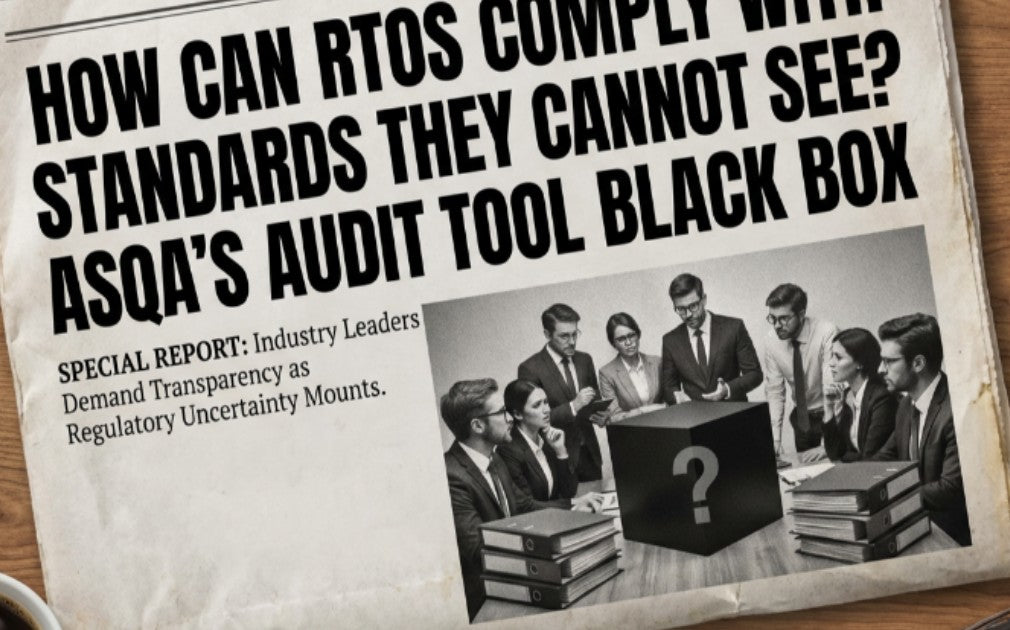
Why is ASQA refusing to publish internal audit checklists, tools and templates to support RTOs during the transition to the 2025 Standards?
This article unpacks that question in depth, explores the legal and compliance context, analyses the risks for RTOs, and reflects on what the sector urgently needs from the regulator.
It is an article that has become necessary because the gap between ASQA’s expectations and the support materials provided is widening, and that has real consequences for the sector’s quality, safety and stability.
The Question That Sparked Sector-Wide Discussion: “Will ASQA Release an Internal Audit Tool?”
During the webinar Q&A, the second question posed to ASQA was one that nearly every RTO leader, consultant and compliance manager wanted answered:
“Will ASQA release an internal audit tool, checklist or audit template aligned to the 2025 Standards?”
Source: ASQA
The answer delivered was clear, direct and, for many, including me, deeply disappointing:
No, ASQA will not release a tool or template. The Standards are flexible, and therefore, tools should be developed by RTOs themselves.”
This single response set off an immediate wave of commentary across the sector.
If the regulator expects RTOs to demonstrate compliance through evidence-based, outcomes-driven systems, aligned to 19 topic areas and 98 performance indicators, why would it not provide a baseline instrument that clarifies the expected evidence?
Why leave 4,400 RTOs to interpret the Outcome Standards independently and risk inconsistent internal audits, misinterpretations, unnecessary panic and unintentional non-compliances?
Why create a situation where two auditors could interpret the same Standard differently because there is no standardised audit reference tool?
And why, at a time when RTOs are navigating the biggest reform in a decade, withdraw the very support that could provide consistency, clarity and fairness?
The sector is not asking ASQA to run internal audits for providers. It is asking for clarity, consistency and a fair starting point.
Why This Issue Matters: Internal Audit Tools Are Not “Optional Extras” in a Risk-Based System
Under the 2025 Standards, RTOs are expected to:
-
design their own audit systems;
-
evaluate themselves against outcome standards;
-
determine whether they are “effectively” meeting outcomes; and
-
continuously improve through structured review cycles.
The Explanatory Statement emphasises repeatedly that the 2025 Standards aim to move RTOs “from baseline compliance to continuous improvement in VET quality and integrity.”
To do that, RTOs must have strong internal audit systems and documented evidence demonstrating:
-
governance oversight;
-
training quality;
-
assessment system integrity;
-
student support;
-
facilities and equipment adequacy;
-
cultural safety compliance;
-
risk management;
-
workforce capability; and
-
consistency of assessment judgements.
This is not a small task. It is a complete system rebuild for nearly every provider.
In fact, Standard 4.4 explicitly requires RTOs to:
“Use data, outcomes, and feedback to continuously improve the quality of services.”
Standard 2.7 requires clearly documented complaint systems.
Standard 1.3, 1.4, 1.5 require assessment systems that are valid, reliable, fair and flexible.
Standard 5 requires leaders to implement governance systems that produce quality outcomes.
And across the entire legislation, the term “documented” appears repeatedly.
The law is unambiguous: You cannot demonstrate compliance without a documented internal audit system.
But how can an RTO design an audit system without knowing:
-
What evidence ASQA expects;
-
Which documents will be considered valid or invalid?
-
What the audit structure will look like;
-
How ASQA will interpret key phrases like “effectively”, “appropriate”, “sufficient” or “fit for purpose”;
-
What does the regulator’s baseline consistency tool look like internally?
No organisation can align with an invisible benchmark.
Why Sector Professionals Disagree With ASQA’s Answer
Hundreds of leaders, consultants and educators in the session immediately voiced their disagreement, even if quietly, through private messages, comments or direct emails afterwards.
The reasoning is simple:
If the Standards are outcomes-based and rely on interpretation, the sector needs a shared reference point to ensure consistency. Without it, compliance cannot be fair, equal or transparent.
Here are the key arguments raised by practitioners:
Outcome Standards require interpretive judgement, not simple checklists
This is true, and precisely the problem.
Outcome-based frameworks demand greater clarity, not less. Because if the benchmark is not fixed, then neither is compliance.
Two auditors could reach two completely different conclusions about the same evidence, simply because they were applying different mental frameworks.
Without an ASQA-provided framework, this variation becomes a systemic risk.
Internal audit tools prevent accidental non-compliance
Under the 2015 Standards, RTOs had a decade of history, case law, examples, audit reports and guidance to rely on.
Under the 2025 Standards:
-
Every RTO is starting from zero,
-
Every clause has a changed structure,
-
New topics have replaced numbered standards,
-
98 performance indicators are spread across complex themes, and
-
Risk is higher than ever before.
A sector-wide baseline audit tool would reduce accidental gaps, promote consistency and support fairness.
Every major regulator globally provides audit templates
Across Australia’s regulatory landscape:
-
TEQSA provides audit guides.
-
ACNC provides governance standards checklists.
-
AHPRA provides audit tools for practitioners.
-
ASIC provides compliance templates.
Internationally:
-
OFQUAL (UK) publishes audit guides for post-secondary providers.
-
NZQA publishes Self-Assessment Guidelines.
-
SAQA (South Africa) publishes detailed audit templates.
The only regulator withholding audit tools is ASQA.
Tools do not reduce flexibility; they increase fairness
The argument that templates reduce flexibility misunderstands their purpose.
A template does not prescribe how an RTO must comply. It clarifies what must be evidenced.
Flexibility is still unlimited. Evidence pathways remain unlimited. Interpretation remains contextual.
But fairness comes from shared expectations.
Not releasing audit tools increases risk for all providers
Especially small RTOs, community providers, First Nations organisations, regional providers and not-for-profits.
These providers do not have:
-
large compliance teams,
-
specialised lawyers,
-
paid consultants reviewing their systems,
-
dedicated audit staff, or
-
the capacity to experiment with interpretation.
To tell these organisations: “Just invent a system yourself” is equivalent to saying: “Good luck, hope you interpret the law correctly.”
That is not equity. It is not a transparent regulation. It is not good governance.
What the Legislation Actually Implies About Consistency
Although the Standards do not explicitly require ASQA to publish internal audit templates, the Explanatory Statement and the structure of the Instrument show a clear regulatory intention:
Outcome Standards require shared definitions of “effective”
The Statement says that terms like “effectively” are deliberately flexible to promote innovation, but must still be anchored by evidence.
The question is: What evidence?
The Standards require RTOs to use data and evidence in continuous improvement
But continuous improvement cycles require:
-
a baseline,
-
a measurement framework,
-
an evaluation system.
These cannot exist without clarity.
Governance obligations require RTO leaders to actively manage integrity
Standard 4.1 requires:
“Governing persons lead a culture of integrity, fairness and transparency.”
If ASQA wants RTOs to lead with transparency, the regulator must model transparency.
Providing templates is transparent.
Withholding them is not.
The audit process itself must be consistent and equitable
If RTOs are required to demonstrate compliance, then auditor expectations must reflect:
-
procedural fairness,
-
alignment with the legislative instrument,
-
consistency of interpretation,
-
objective criteria.
Without a shared evidence framework, none of that is reliably possible.
What Happens When Internal Audit Tools Are Missing: Real Examples from the Sector
Over the past decade, I have seen hundreds of cases where ambiguity in requirements led to:
-
contradictory audit findings;
-
inconsistent assessment of identical evidence;
-
conflict between auditors and RTO staff;
-
catastrophic non-compliances that were avoidable;
-
appeals and reconsiderations that cost RTOs thousands.
Here are three anonymised scenarios illustrating why the sector needs a standard audit template.
Example 1: The “Sufficient Evidence” Problem
Two RTOs submit evidence for a practical unit requiring students to demonstrate multiple tasks over time.
RTO A presents:
-
3 observations
-
1 third-party report
-
1 candidate logbook
RTO B presents:
-
1 observation
-
2 simulations
Both apply assessment principles and rules of evidence.
In a world without a shared audit template:
-
Auditor 1 says RTO A is compliant, RTO B is not.
-
Auditor 2 says both are compliant.
-
Auditor 3 says neither is compliant because neither has workplace evidence.
Three auditors, three interpretations. One set of Standards. Zero consistency.
This is what happens when the regulator does not publish its own audit tool.
Example 2: The “Training Volume and Pace” Discrepancy
An RTO delivers Certificate III online with 20 hours per week of guided learning.
Another RTO delivers the same qualification face-to-face with 6 hours per week.
Both provide:
-
session plans,
-
timetables,
-
resources,
-
attendance data.
One auditor interprets Standard 1.1 as “sufficient learning volume”. Another says it is “not suitably paced for the learner cohort.”
When Standards depend on the subjective interpretation of “appropriate”, providers are left guessing.
Without a template explaining the evidence ASQA considers appropriate, RTOs cannot design systems that reflect reasonable expectations.
Example 3: The Cultural Safety Compliance Gap
A First Nations learner raises concerns about cultural safety under Standard 2.5.
The RTO has:
-
a Reconciliation Action Plan
-
First Nations artwork in its Student Handbook
-
a statement of acknowledgment
-
a complaints procedure
But it does not have:
-
evidence of co-design with First Nations communities,
-
culturally safe complaint pathways,
-
a process for identifying racism risks,
-
First Nations staff involvement in training design.
Does this meet Standard 2.5? Some auditors may say yes. Others may say no. And without guidance or a template:
-
RTOs do not know what “effective cultural safety” evidence looks like.
-
First Nations voices risk being marginalised.
-
The regulator cannot claim improvement without transparent measurement.
This is exactly why audit templates matter.
The Sector’s Response: “This Is the Wrong Time for ASQA to Step Back.”
Every consultant, every RTO compliance manager, every risk specialist has said the same thing since the webinar:
The 2025 Standards represent the most complex compliance shift the sector has seen in years. This is not the time for ASQA to take a hands-off approach.
The Standards are:
-
new,
-
outcomes-based,
-
multi-layered,
-
less prescriptive,
-
spread across 19 topic areas,
-
centred on evidence and interpretation,
-
anchored in continuous improvement.
RTOs need:
-
clarity,
-
structure,
-
fairness,
-
consistency.
The absence of audit tools threatens all of these.
Why This Matters Far Beyond Documentation: Governance, Risk and System Stability
This issue is not about whether RTO managers want an “easy way out”.
It is about system integrity.
Without shared audit tools:
-
Governance consistency is compromised.
-
Risk management becomes reactive instead of proactive;
-
Evidence systems become misaligned.
-
Small providers fall behind.
-
Community RTOs struggle.
-
First Nations providers face unnecessary hurdles;
-
Poor-quality providers slip through gaps.
-
Audit outcomes become unpredictable.
-
Sector trust erodes.
The ripple effect is real:
-
Employers lose confidence in qualifications.
-
Learners question the value of credentials.
-
Policymakers lose transparency.
-
High-quality RTOs get punished for doing the right thing.
-
Low-quality operators find loopholes.
In a national training system, inconsistency is not a minor issue. It is a systemic risk.
What ASQA Could Provide, Without Creating Prescriptive Compliance
Here is the important point: Audit tools do not need to be prescriptive.
ASQA could release:
-
an evidence matrix,
-
a compliance crosswalk,
-
a sample internal audit structure,
-
a mapping reference sheet,
-
an audit-readiness guide,
-
examples of valid evidence,
-
a sector-wide “minimum evidence expectations” guide.
None of these would reduce flexibility. They would simply improve fairness.
They would allow RTOs to innovate safely, not blindly.
And they would bring consistency to a system that is about to undergo massive structural change.
A Simple Proposal: Publish the Audit Checklist Used By ASQA, Even If It Is High Level
There is a very simple solution:
Publish the high-level internal audit tool ASQA itself uses when conducting performance assessments.
Even if it is:
-
high level,
-
flexible,
-
non-prescriptive,
-
topic-based.
The sector does not need a template that says:
“Provide Document A, B or C.”
It needs a template that says:
“Here are the areas of evidence an auditor will examine under each Standard.”
This reduces uncertainty without limiting innovation.
It allows RTOs to build systems that mirror the regulator’s expectations.
It supports fairness, transparency and equity.
And it reduces the risk of inconsistent interpretations—something that has plagued the sector for over a decade.
Where To From Here: The Sector’s Next Steps
The sector is already discussing next steps.
Based on the feedback, here is what the industry is calling for:
A Public Request for ASQA Audit Templates
Many leaders are now recommending that RTOs collectively request ASQA to publish:
-
internal audit tools,
-
evidence matrices,
-
or at a minimum, high-level audit frameworks.
Sector-Wide Collaboration to Develop a Shared Template
If ASQA does not release one, the sector may:
-
form a working group;
-
co-design a template with consultants;
-
build a shared evidence mapping framework;
-
support smaller RTOs;
-
publish a community-developed audit guide.
First Nations Consultation for Outcome Standards 2.5 and 2.6
Outcome Standards 2.5 (Diversity and Cultural Safety) and 2.6 (Wellbeing) require specific cultural and community expertise.
A core expectation of the sector is that:
-
First Nations experts should be co-authors of any audit tool,
-
Cultural safety criteria must be validated by First Nations peoples,
-
ASQA must involve Aboriginal and Torres Strait Islander leaders in this process.
A Coherent Interpretation Framework for “Effective Delivery” and “Quality Outcomes”
Without clear expectations, these phrases will be interpreted inconsistently.
The sector needs clarity on:
-
assessment evidence requirements;
-
“appropriate” training volume;
-
“suitable” modes of delivery;
-
“effective” RPL advice;
-
“fit-for-purpose” facilities and equipment.
ASQA Should Release Q&A Fact Sheets Promptly
Many questions were left unanswered.
A regulator cannot claim transparency if it does not answer the sector’s most pressing questions.
The Sector Cannot Be Expected To Comply With Invisible Standards
The 2025 Standards are a major step forward, if implemented with clarity, consistency and fairness.
Outcome-based regulation can lift quality. It can encourage innovation. It can promote student-centred delivery.
But it cannot succeed without:
-
shared reference points;
-
transparent audit expectations;
-
clear evidence frameworks;
-
culturally grounded criteria;
-
sector-wide understanding.
When a regulator says:
“No, we will not release an audit tool because flexibility matters.”
The sector hears:
“You are responsible for interpreting the most significant compliance reform in a decade without guidance.”
And that is not flexibility. That is risk.
-
Risk for RTOs.
-
Risk for students.
-
Risk for employers.
-
Risk for the VET system.
The solution is simple:
-
Publish an audit framework.
-
Provide a baseline tool.
-
Support consistency.
-
Reduce risk.
-
Strengthen integrity.
-
The sector is ready.
Now the regulator must meet it halfway.