
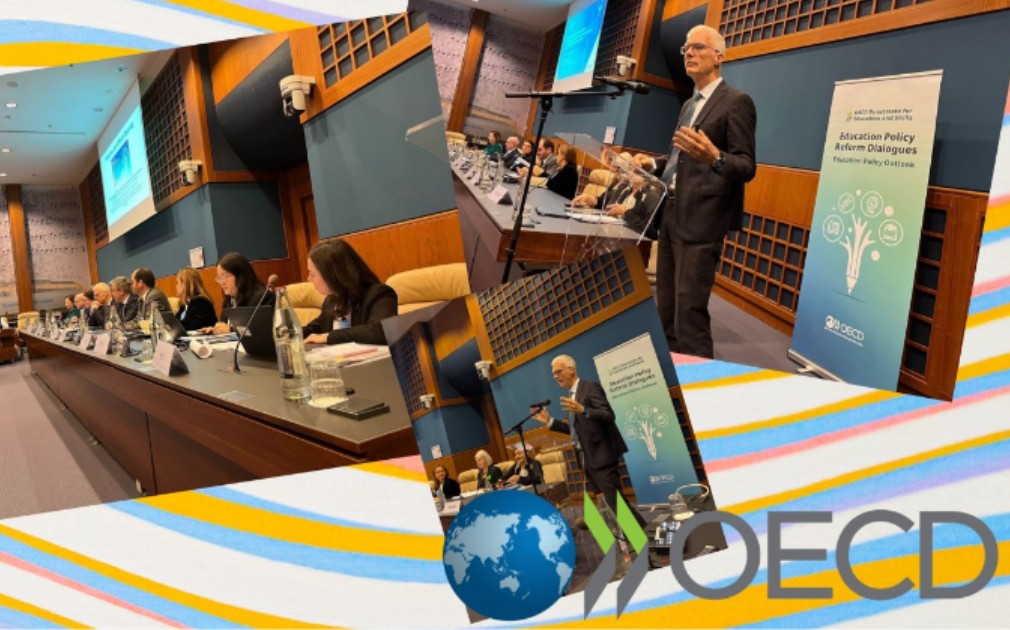
The OECD is an intergovernmental organisation where mainly high‑income, democratic countries work together to improve economic and social policy. Its name stands for the Organisation for Economic Co‑operation and Development, and it is headquartered in Paris, France. The OECD has 38 member countries that use the organisation as a forum to compare policy experiences, discuss shared challenges, and coordinate domestic and international policies. Its core aims include promoting sustainable economic growth, boosting employment, raising living standards, maintaining financial stability, supporting development in other countries, and contributing to the expansion of world trade. The OECD collects and analyses data, produces comparative indicators, and conducts peer reviews in areas such as education, taxation, trade, environment, employment, and innovation. It also develops non‑binding “soft law” standards and guidelines (for example, on multinational enterprises, tax transparency, and education quality) that many countries use as global benchmarks. Because its members account for a large share of global GDP and trade, OECD evidence and standards are highly influential in shaping national reforms and international rules. Governments, researchers and organisations rely on OECD reports (like PISA, Education Policy Outlook, and employment or tax outlooks) to assess performance, learn from other countries, and design better policies for economic and social well‑being.
The OECD Education Policy Outlook 2025 offers one of the most comprehensive examinations of how countries are adapting their education and training systems to a world defined by rapid technological change, demographic shifts and evolving labour-market expectations. Far beyond the brief launch summary, the full report presents a detailed, data-rich analysis of more than 230 policies from 35 education systems, revealing clear global patterns in participation, outcomes, and reform priorities across all ages.
This year’s edition, released during the Education Policy Reform Dialogues 2025 under the theme “Nurturing engaged and resilient lifelong learners in a changing world,” positions lifelong learning not as a desirable extra but as a structural necessity for economic resilience, equity and social cohesion.
A workforce shaped by yesterday’s skills
A striking reality highlighted by the report is that many of today’s adults graduated with qualifications designed for an entirely different era. Their initial education often predates the technologies, industries and digital capabilities that now define modern work.
This mismatch means that millions of workers worldwide, including in Australia, may not have the foundational or transferable skills required to navigate emerging fields such as artificial intelligence, cybersecurity, advanced manufacturing, green technologies and complex health systems. The traditional model of “front-loaded education” can no longer sustain a full career.
The OECD stresses that without strong adult-learning systems, the skills gap will widen, productivity will decline, and the risk of long-term unemployment will grow.
Lifelong learning as economic infrastructure
The report makes it clear that lifelong learning is no longer optional; it is an economic infrastructure. Countries that fail to invest in it will face skill shortages, wage stagnation and widening inequality. Countries that invest in it will gain a more resilient workforce capable of adapting to rapid technological change.
The most effective systems share several characteristics:
Accessible learning pathways across all ages, qualifications and industries. Flexible delivery models that support work-study balance and digital participation. Recognition of prior learning (RPL) frameworks that value experience and accelerate upskilling. Strong industry involvement in designing training and ensuring relevance. Targeted support for vulnerable groups to prevent skill gaps from becoming social divides.
Australia is making progress in these areas, particularly through VET reform, micro-credentials, and government-funded upskilling programs. But the OECD notes that consistency, coordination and long-term investment remain essential.
Performance and Participation: Warning Signs Across Systems
Across the OECD’s communication channels, one concern stands out sharply: many participating countries are seeing academic outcomes either stall or decline. Recent international assessments show worrying stagnation in foundational skills such as literacy, numeracy and problem-solving: critical prerequisites for lifelong learning.
At the same time, participation in adult learning is falling in several countries, even as the skills needed in modern labour markets change faster than ever. This dual trend, lower skill outcomes and declining adult participation, signals a widening structural gap between what economies require and what education systems currently provide.
For policymakers, the message is unambiguous: if adult learning stagnates while technology accelerates, national productivity, economic resilience and social equity will all be at risk.
Why lifelong learning matters now more than ever
The global shifts reshaping work — automation, AI, demographic ageing, digital transformation and the green transition — mean that the half-life of skills is shrinking. What you learned 10 years ago may no longer be enough to keep pace with today’s demands.
The OECD’s message is clear: workers need continuous opportunities to refresh and expand their capabilities, and education systems must evolve to meet these new realities.
This also requires cultural change. Lifelong learning must be seen not as remediation for those who “fall behind,” but as a universal expectation, a shared national priority and a driver of collective prosperity.
The Will–Skills–Means Framework: A Clear Lens on System Gaps
One of the report’s most valuable contributions is its application of the Will–Skills–Means framework to every stage of learning:
Will — attitudes, motivation and agency
Skills — foundational, digital and higher-order competencies
Means — time, money, opportunities, support, recognition
Each policy is coded against these three dimensions, as well as the four “moments that matter” across the life course:
-
Early childhood
-
Early to mid adolescence
-
Mid-career
-
Approaching retirement
This gives policymakers a powerful diagnostic tool. Early analysis shows that many systems concentrate heavily on building Skills and expanding Means, but invest far less in nurturing Will — the learner attitudes and agency that ultimately determine participation and persistence. The framework also reveals where countries over-invest early and under-invest later, contributing to weaker adult-learning systems.
A call to action for educators, industries and governments
The new Education Policy Outlook is more than a report — it is a roadmap for modernising education in ways that align with labour-market needs, social equity and economic resilience.
For Australia and many other nations, this means:
• strengthening the VET and higher-education interface
• expanding work-integrated learning
• improving career guidance across the lifespan
• supporting adult learners financially and structurally
• incentivising employers to invest in training
• ensuring that no group is left behind in the transition
The future workforce will not be built through one-time qualifications. It will be built through ongoing, lifelong access to high-quality education and skill development.
Life-Stage Deep Dive: Where Countries Are Moving
1. Early Childhood
The early-childhood chapter reinforces a well-established evidence base: high-quality early childhood education and care (ECEC) has lasting effects on school readiness, future learning outcomes and lifelong learning attitudes. Countries are increasingly:
• integrating ECEC governance • raising staff qualification requirements • expanding access for disadvantaged families
The trend is toward more coherent, equitable and professionalised systems.
2. Early–Mid Adolescence
As students transition into adolescence, systems are focusing heavily on:
• career guidance reforms • strengthened VET and upper-secondary pathways • wellbeing and mental-health supports • student voice and participation • dropout-prevention measures
These policies aim to protect long-term skill development and employment outcomes by preventing disengagement at a critical stage.
3. Mid-Career
For adults in the workforce — especially those in routine or at-risk jobs — the report highlights growing investment in:
• modular, stackable learning • paid training leave • recognition of prior learning (RPL) • adult-learning accounts • targeted digital-skills programs
The focus is on flexibility and relevance, recognising that adults need pathways that fit complex work-life realities.
4. Approaching Retirement
The chapter on older adults is particularly forward-looking. Workers aged 55+ are treated not as a declining labour resource, but as an under-utilised asset. Countries are adopting policies to support:
• later retirement through flexible work • retraining into less physical roles • community-based learning for health, social engagement and civic participation
This recognises the demographic reality facing OECD countries and the need to sustain participation across the lifespan.
Contextual Signals: Completion, Disruption and Skills Pipelines
The OECD situates the report within wider educational trends:
• Only around four in ten bachelor’s students in many OECD and partner countries complete their degree on time.
• Even with three additional years, completion rates rise only to about seven in ten, raising concerns about efficiency and pipeline leakage.
• Simultaneously, technological disruption and automation demand faster reskilling cycles than education systems currently deliver.
These indicators reinforce the central theme: lifelong learning systems must be strengthened now, not later.
Building education systems that grow with us
The OECD's Education Policy Outlook 2025 makes a compelling case for the urgent need to shift from traditional, front-loaded education models to comprehensive lifelong-learning systems.
In an era defined by rapid technological advancement, demographic shifts, and the constant evolution of work, continuous learning is no longer just a policy goal; it is an economic and social imperative.
The report highlights a critical choice for nations: either proactively invest in adaptable learning ecosystems that support individuals throughout their lives, or risk facing widening skills gaps, reduced productivity, and social inequality.
By strategically investing in the Will, Skills, and Means for lifelong learning across all life stages, countries can build resilient economies, foster adaptable workforces, and create more equitable societies, ultimately securing a competitive advantage in the future.
Acknowledgement: Photo and data courtesy of the OECD (Organisation for Economic Co-operation and Development). The OECD’s analysis, indicators and policy insights provide essential global benchmarking for education, skills and lifelong-learning reform.